
Is an HVAC Maintenance Plan Worth It? Here’s What Homeowners Need to Know
Is an HVAC maintenance plan worth it? For most homeowners, yes — especially if your system is more than three to five years old, you live in a climate with hot summers and cold winters, or you want to protect your manufacturer’s warranty. That said, it’s not the right call for everyone.
Here’s a quick breakdown to help you decide:
When a maintenance plan IS worth it:
- Your system is 3+ years old and sees heavy seasonal use
- You want to avoid surprise emergency repair bills
- Your manufacturer requires documented service to keep the warranty valid
- You live in an area with extreme heat or cold (like the DC metro region)
- You prefer predictable costs over pay-as-you-go repairs
When a maintenance plan may NOT be worth it:
- Your system was just installed and includes a labor warranty
- You are a skilled DIYer who can safely handle refrigerant and electrical checks
- You plan to replace the system within the next 12 months
No one wants to wake up to a freezing house in January or sweat through a DC summer weekend waiting on an emergency repair crew. For homeowners in the Washington D.C., Montgomery County, and Howard County area, where both summer heat and winter cold push HVAC systems hard, the stakes of an unexpected breakdown are real. An HVAC maintenance plan promises to prevent exactly that — but with so many contracts out there, ranging from basic tune-ups to full-coverage agreements, it’s worth asking whether you’re getting genuine value or just paying for paperwork.
The answer isn’t one-size-fits-all. It depends on your system’s age, how you use it, what the plan actually covers, and whether the company behind it delivers on its promises. Some plans genuinely extend equipment life, lower energy bills, and catch small problems before they become expensive ones. Others come loaded with exclusions and hollow priority-service guarantees.
This guide cuts through the noise so you can make a confident, informed decision.
Introduction to Modern HVAC Care
In homeownership in April 2026, we often treat our heating and cooling systems like a toaster: we expect them to work every time we flip the switch, giving them little thought until they fail. However, an HVAC system is more like a vehicle. It has motors, pressurized gases, electrical circuits, and moving parts that endure thousands of hours of operation every year. Modern HVAC care has shifted from “fix it when it breaks” to a model of preventive care and system reliability.
The goal of a modern service strategy is simple: keep the machine running at peak efficiency so it uses less energy and lasts longer. By the time an air conditioner stops blowing cold air or a furnace starts making a grinding noise, the damage is often already done. Proactive maintenance aims to intercept those issues while they are still just “dust on a sensor” rather than “a burnt-out motor.”
Defining the Service Agreement
So, what exactly are we talking about when we mention a maintenance plan or service contract? At its core, a Maintenance Agreement is a scheduled program designed to provide routine inspections and seasonal tune-ups.
Instead of calling a technician only when disaster strikes, you enter into an agreement where professional eyes look at your system at least twice a year. These visits aren’t just “quick looks.” They involve deep cleaning of coils, testing safety controls, and calibrating the system to ensure it meets the manufacturer’s original specifications. A good plan acts as a financial safety net, often bundling these visits with perks like priority scheduling and discounts on any necessary repairs found during the inspection.
Is an HVAC maintenance plan worth it for your home?
When homeowners in Washington D.C., Montgomery County, or Howard County ask us, “is an hvac maintenance plan worth it,” we tell them to look at their utility bills and their calendar. In our region, we experience the full gamut of Mid-Atlantic weather. From the humid, 90-degree days in July to the bone-chilling February nights, your HVAC system rarely gets a true “vacation.”
If you live in Silver Spring or Bethesda, you know that a broken AC in mid-August isn’t just an inconvenience—it’s a localized emergency. This is why many residents opt for specific AC Maintenance Tune-Up Silver Spring MD services or AC Maintenance Tune-Up Washington DC plans. These agreements ensure that when the heatwave hits, your system is already primed to handle the load.
Evaluating the ROI: Is an HVAC maintenance plan worth it?
To determine the Return on Investment (ROI), we have to look beyond the annual fee. The value is found in three main areas:
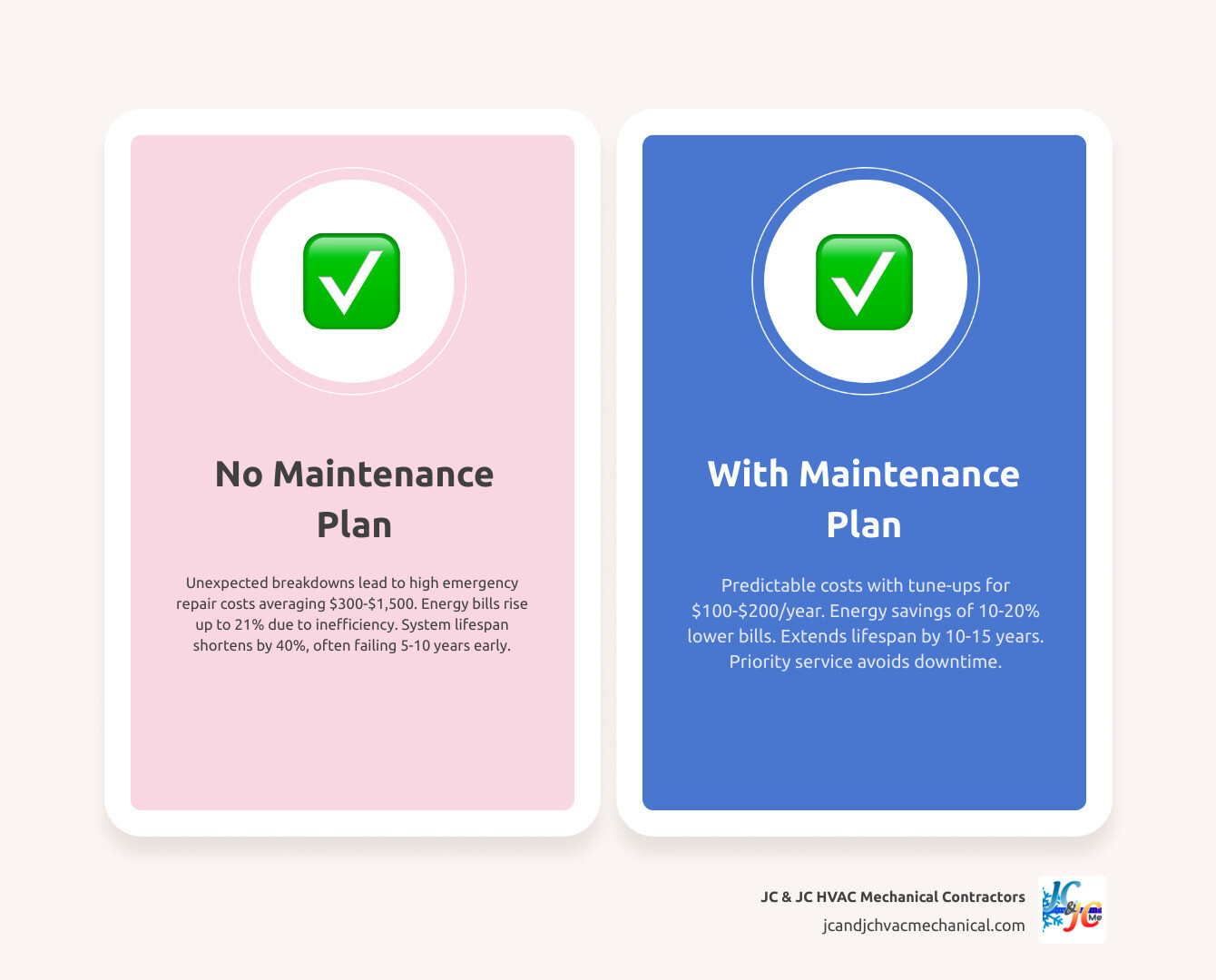
- Energy Efficiency: A dirty system has to work harder. Research shows that dust and debris buildup can reduce efficiency by 10% to 25%. Regular cleaning ensures you aren’t overpaying the utility company every month.
- Repair Avoidance: Most major HVAC failures don’t happen overnight; they build up. A technician might find a $20 capacitor that is starting to bulge. Replacing it now prevents a $2,000 compressor failure later. This is the definition of “loss prevention.”
- Property Value and Longevity: A well-documented service history is a massive asset if you ever decide to sell your home. Beyond that, How Long Do Air Conditioners Last and How Can AC Tune-Ups Help? The data suggests that maintained systems can last 15 to 20 years, whereas neglected ones often fail around the 8-to-10-year mark.
When to Invest vs. When to Skip
We believe in being honest with our neighbors in Rockville and Potomac. A plan isn’t mandatory for everyone.
Invest if:
- Your system is older: If your unit is out of its initial labor warranty period, a plan is your best defense against rising repair costs.
- You have a Heat Pump: Since heat pumps work year-round for both heating and cooling, they experience double the wear and tear and need twice-yearly attention.
- You value “Front of the Line” status: If your AC dies during a 100-degree week, being a plan member usually guarantees you priority service while others may wait days for a technician.
- You’re wondering Is July Too Late to Get AC Maintenance Done? (Hint: It’s never too late to prevent a total breakdown, but earlier is always better).
Skip if:
- You’re moving soon: If you are selling the house in six months, a long-term maintenance contract might not be your priority.
- The system is brand new with a 10-year labor warranty: Some installers include the first few years of maintenance or provide a labor warranty that covers everything, making an additional plan redundant for a short period.
Key Benefits of Professional Maintenance
When you sign up for a Maintenance Agreement, you aren’t just buying a “check-up.” You are buying a comprehensive suite of benefits that a standard one-time service call usually lacks.
| Feature | Pay-Per-Visit | Maintenance Plan Member |
|---|---|---|
| Scheduling | You have to remember to call | Proactive reminders/automated scheduling |
| Response Time | Standard (can be days in peak season) | Priority “Front of the Line” status |
| Repair Costs | Full price for parts and labor | 10% to 20% discounts common |
| Diagnostic Fees | Standard fee applies | Often waived or significantly reduced |
| Emergency Service | Extra after-hours fees | Often discounted or included |
Long-term value: Is an HVAC maintenance plan worth it?
The real “meat” of a maintenance plan is the technical work performed. During these visits, we focus on component protection. For example, AC Maintenance involves cleaning the evaporator and condenser coils. If these are caked in Potomac pollen or Silver Spring dust, your system can’t release heat, causing the compressor to overheat and die prematurely.
Similarly, Heater Maintenance is about more than just warmth; it’s about safety. We perform safety inspections on gas connections and heat exchangers. A cracked heat exchanger isn’t just a repair issue—it’s a carbon monoxide risk. A maintenance plan ensures these life-safety checks happen like clockwork every autumn.
Protecting Your Manufacturer Warranty
This is the “fine print” that catches many homeowners off guard. Most major manufacturers (like Trane, Carrier, or Lennox) require documented professional maintenance to keep their 10-year parts warranties valid. If your compressor fails in year seven, the manufacturer may ask for proof that the system was serviced annually. If you can’t provide those records, they can legally deny your claim, leaving you with a bill for thousands of dollars.
Understanding What is Included in HVAC Maintenance and Why It’s Important is the first step in ensuring your warranty remains a shield, not a discarded piece of paper.
Homeowner Tasks vs. Professional Requirements
We often get asked if a homeowner can just “do it themselves” to save money. While we encourage proactive home care, there is a clear line between what you should do and what requires a pro.
The Homeowner Checklist:
- Filter Replacement: This is the #1 thing you can do. Check your filters every 30 to 90 days. A clogged filter is the leading cause of system “suffocation.”
- Debris Removal: Keep the area around your outdoor unit clear. Cut back weeds and remove leaves or grass clippings from the fins.
- Thermostat Settings: Ensure your batteries are fresh and your programming aligns with your current schedule.
- Spring Cleaning: Follow The Ultimate Spring Cleaning Checklist for Your HVAC System to keep the visible parts of your system tidy.
Technical Services Requiring an Expert
There are things you simply cannot—and should not—do without specialized tools and training. For instance, With Winter Coming, Get Your HVAC Serviced with Proper Heater Maintenance because a professional needs to test the limit switches and flame sensors.
Other expert-only tasks include:
- Checking Refrigerant Levels: Handling refrigerant requires an EPA certification. If your levels are low, you have a leak that needs to be found and sealed, not just “topped off.”
- Electrical Connections: We tighten all electrical terminals. Loose wires cause “pitting” and can lead to expensive control board failures or even fire hazards.
- Heat Exchanger Inspection: Detecting microscopic cracks in a furnace requires specialized cameras or dye tests.
- Timing: Knowing When’s the Best Time of Year to Get Your Heater Serviced? (usually early fall) is part of the professional strategy to ensure you aren’t testing your furnace for the first time on the coldest night of the year.
Frequently Asked Questions
How often is HVAC maintenance recommended?
Standard industry practice—and our recommendation for the D.C. metro climate—is twice a year. We suggest a “Spring Cooling Check” for your air conditioner and a “Fall Heating Check” for your furnace or boiler. If you have a heat pump, these biannual visits are even more critical because the system never gets a season off. Plans are typically designed to align perfectly with this frequency, taking the guesswork out of your calendar.
What common repairs are excluded from plans?
It is important to read the fine print. Most maintenance plans are service agreements, not insurance policies. They cover the labor for the tune-up and offer discounts on repairs, but they usually do not provide “free” major components. Common exclusions include:
- Pre-existing conditions: If your system is broken when you sign up, the plan won’t cover that initial repair.
- Ductwork design: Fixing leaky or poorly designed ducts is usually a separate project.
- External plumbing/electrical: Issues with the main home drain lines or the circuit breaker panel are typically outside the scope of an HVAC contract.
How do I choose a reputable HVAC provider?
Don’t just go with the cheapest flyer in the mail. Look for:
- Local Experience: A company that understands the specific challenges of Bethesda, Laurel, and Germantown homes.
- Certified Technicians: Ensure the people entering your home are trained and background-checked.
- Transparent Terms: You should know exactly what is included in the 20-point or 40-point checklist.
- Reviews: Look for a track record of reliability. For example, there are 6 Reasons to Choose JC & JC for Your Heating Repair and Maintenance, including our commitment to professional, expert service and our 270+ excellent reviews from your neighbors.
Conclusion
So, is an hvac maintenance plan worth it? When you consider that your HVAC system is likely the most expensive appliance in your home, protecting it with a professional plan isn’t just a “perk”—it’s a smart financial strategy. It’s the difference between a small, planned service fee and a massive, unplanned emergency replacement bill in the middle of a July heatwave.
At JC & JC HVAC Mechanical Contractors, we’ve spent years keeping homes comfortable in Washington D.C., Silver Spring, Bethesda, and throughout Montgomery and Howard Counties. We believe that “planned comfort” is the best way to save money and ensure your family’s safety year-round.
Ready to stop venting cash and start protecting your investment? Explore our Maintenance Agreement today and breathe easier knowing your home’s most vital system is in expert hands.