
Why Spring Is the Most Important Time to Check Your AC and HVAC System
A spring ac and hvac maintenance checklist is the single most effective thing you can do to keep your cooling system running reliably all summer long — before the Maryland and D.C. heat makes every HVAC technician’s schedule impossible to crack.
Here is a quick overview of the essential tasks to complete this spring:
DIY Tasks (Homeowner):
- Replace or inspect air filters (every 30-90 days)
- Clear debris from around the outdoor condenser unit (maintain 2-foot clearance)
- Flush the condensate drain line with diluted white vinegar
- Test your thermostat by switching to cool mode
- Check that all supply and return vents are open and unobstructed
- Inspect foam insulation on refrigerant lines for cracks or wear
Professional Tasks (Certified Technician):
- Check and adjust refrigerant levels
- Clean evaporator and condenser coils
- Test and tighten electrical connections
- Inspect and test capacitors and contactors
- Lubricate motor bearings and moving parts
- Inspect ductwork for leaks
- Verify system safety controls and starting cycle
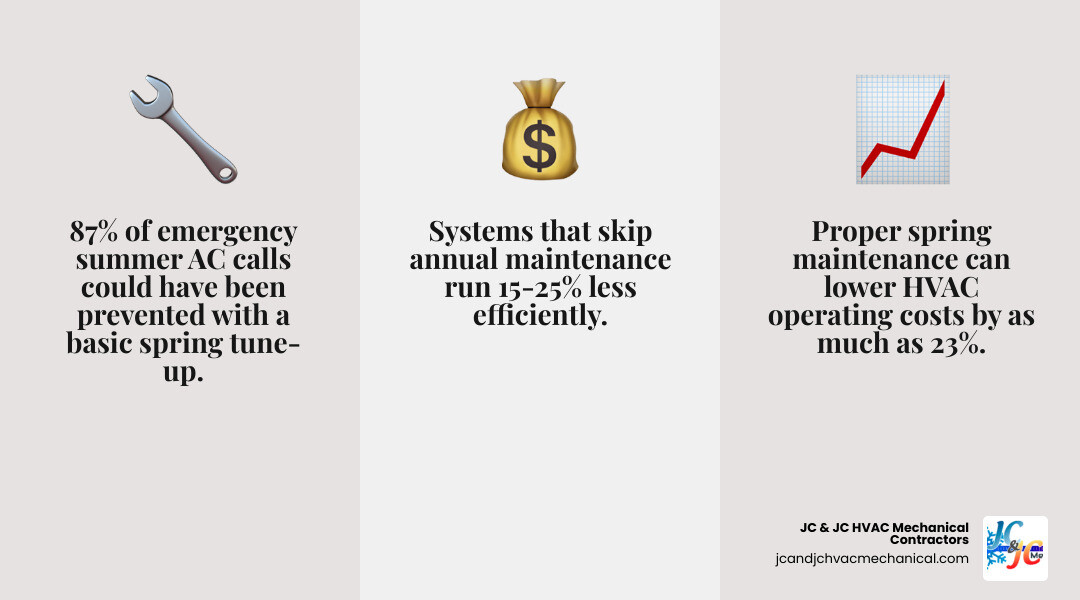
Most HVAC systems fail on the hottest day of the year — not by bad luck, but because small problems that built up quietly all winter finally give out under peak load. Research from HVAC contractors consistently shows that 87% of emergency summer AC calls could have been prevented with a basic spring tune-up. Systems that skip annual maintenance run 15-25% less efficiently, break down more often, and can have their useful lifespan cut by 5-10 years compared to properly maintained units.
If you own a home in the suburban Maryland or D.C. area, the combination of humid summers and hard-working cooling seasons makes proactive spring maintenance even more critical. Getting your system inspected and tuned up in March or April — before the rush — means faster scheduling, and more importantly, an AC that works when you need it most.
Why a Spring AC and HVAC Maintenance Checklist is Essential
As we move into April 2026, the transition from chilly Maryland mornings to humid afternoons begins. This seasonal shift is the perfect reminder that your air conditioner has likely been sitting dormant for months. Neglecting your system during this time is a gamble that rarely pays off.
One of the biggest reasons to prioritize your spring ac and hvac maintenance checklist is pure efficiency. When your condenser coils are caked in dirt or your filters are clogged, your system has to work significantly harder to move air and dissipate heat. This extra effort doesn’t just show up as a higher number on your Pepco or BGE bill; it physically wears down the internal components. Statistics show that proper spring maintenance can lower HVAC operating costs by as much as 23%.
Furthermore, What is included in HVAC maintenance and why its important? goes beyond just a quick cleaning. It is about safety and longevity. For instance, faulty wiring is responsible for roughly 13% of home electrical fires. A spring check-up allows us to catch loose connections or frayed wires before they become a hazard.
Regular attention also directly impacts how many years of service you get out of your investment. How long do air conditioners last and how can AC tune-ups help is a question we hear often in Bethesda and Rockville. While a neglected system might only last 10 to 12 years, a well-maintained unit can easily reach 15 to 20 years of reliable service. By reducing the risk of summer breakdowns by 95%, you aren’t just saving money on repairs; you’re buying peace of mind for those 90-degree July days.
Essential DIY Tasks for Your Spring AC and HVAC Maintenance Checklist
While many parts of an HVAC system require a professional touch, there are several high-impact tasks you can handle yourself to keep things running smoothly. Taking an hour or two on a Saturday morning in Beltsville or Bowie to walk through these steps can prevent a lot of headaches later.
1. Master the Air Filter
If you do only one thing for your HVAC system this spring, make it the air filter. A clogged filter forces your blower motor to work 15% harder, which leads to premature motor failure. We recommend checking your filters every 30 days during peak cooling months. If you have pets or suffer from seasonal allergies in the D.C. area, you may need to replace them more frequently. For a deeper dive into home care, check out The ultimate spring cleaning checklist for your HVAC system.
2. Clear the Outdoor “Zone”
Your outdoor condenser unit needs to “breathe” to release the heat it pulls from your home. Over the winter, leaves, twigs, and grass clippings often pile up against the unit. Use a broom or a gentle garden hose (never a pressure washer!) to clear away debris. Ensure there is at least a 2-foot clearance around the entire unit. Trim back any shrubs or decorative grasses that have grown too close.
3. Prevent the “Great Indoor Flood”
Your AC removes a surprising amount of water from the air. This moisture travels through a condensate drain line. Over time, algae and mold can grow inside this pipe, causing a backup that can flood your utility room or damage your ceiling. You can prevent this by pouring a cup of diluted white vinegar down the drain line access port once a month during the spring and summer.
4. Thermostat and Vent Audit
Before the first heatwave hits, switch your thermostat to “Cool” and set it 5 degrees below the current room temperature. Listen for the system to kick on smoothly. While you’re at it, walk through your home and ensure no furniture, rugs, or curtains are blocking your supply or return vents. Blocked vents create pressure imbalances that can actually damage your ductwork.
Your DIY Spring Maintenance Toolkit:
- Fresh air filters (check your size!)
- Screwdriver (to remove vent covers for cleaning)
- Garden hose (for gentle coil rinsing)
- White vinegar (for the drain line)
- Vacuum with brush attachment (for indoor registers)
For homeowners who want to ensure they never miss a step, our Maintenance agreement provides a structured way to keep your system in top shape without the guesswork.
Professional Steps in a Spring AC and HVAC Maintenance Checklist
While DIY tasks are great for day-to-day upkeep, there are technical aspects of your cooling system that require specialized tools and EPA-certified expertise. When we perform a professional AC maintenance visit, we go deep into the “heart” of your system to ensure every component is performing at factory specifications.
Refrigerant and Coil Precision
Checking refrigerant levels is not a DIY job. Handling refrigerants requires specific certification, and having too much or too little can destroy your compressor. We also perform a deep cleaning of the evaporator and condenser coils. Dirty coils can reduce cooling efficiency by as much as 30%, making your home feel “clammy” even when the air is blowing.
Electrical and Mechanical Integrity
Loose wires cause 30% of all AC failures. During a professional tune-up, we tighten all electrical connections and test the capacitors. Capacitors are like the “batteries” that give your motors the jolt they need to start. They often fail during the first hot week of the year, so testing them in the spring prevents a mid-summer emergency.
Whether you need an AC maintenance tune-up Silver Spring MD or an AC maintenance tune-up Washington DC, our technicians also focus on:
- Blower Calibration: Ensuring the fan is moving the exact amount of air required for your home’s size.
- Safety Controls: Testing limit switches to ensure the system shuts down safely if it overheats.
- Motor Lubrication: Reducing friction in older motors to lower energy consumption and prevent “burnout.”
- Ductwork Inspection: Checking for visible leaks or disconnected sections that waste conditioned air.
Optimizing Indoor Air Quality and Efficiency
Spring in the Potomac and Silver Spring areas means pollen is everywhere. Your HVAC system is your home’s first line of defense against outdoor pollutants. During your spring maintenance, we look for ways to improve the air you breathe while simultaneously boosting efficiency.
Leaky ductwork is one of the biggest “silent” energy wasters. The Department of Energy estimates that the average home loses 20% to 30% of its conditioned air through holes and poor connections in the ducts. By sealing these leaks, you ensure that the air you’re paying to cool actually reaches your bedrooms rather than escaping into the attic.
Comparing Air Filter Options:
| Filter Type | Efficiency | Best For |
|---|---|---|
| Standard Fiberglass | Low | Basic protection for the equipment only |
| Pleated (MERV 8-11) | Medium | Most homes; balances airflow and filtration |
| HEPA / High-MERV | High | Severe allergies or respiratory issues |
| Media Filters | Very High | Long-lasting (6-12 months); excellent air cleaning |
Beyond filters, we often recommend UV lights or whole-home air purifiers. These systems work within your ductwork to kill mold spores and bacteria that thrive in the damp environment of an AC evaporator coil. For more tips on refreshing your home’s air, revisit The ultimate spring cleaning checklist for your HVAC system.
Frequently Asked Questions about Spring HVAC Maintenance
When is the best time to complete a spring ac and hvac maintenance checklist?
The ideal window is March and April. Scheduling your service during these months ensures your system is ready before the first “surprise” heatwave in May. It also allows for easier scheduling; by late May and June, technicians are often booked out for weeks responding to emergency repairs. If you find yourself asking Is July too late to get AC maintenance done, the answer is no — it’s always better late than never — but spring is definitely the “Goldilocks” zone for service.
What are the risks of neglecting a spring ac and hvac maintenance checklist?
Neglect is the primary cause of system failure. Without a tune-up, you risk an emergency breakdown during a heatwave, which often results in much higher repair costs compared to a preventative visit. You’ll also deal with 15-25% higher energy bills, poor indoor air quality, and a shortened system lifespan. You can find more details on why these checks matter in our guide: What is included in HVAC maintenance and why its important?.
How often should I replace filters during the spring?
Most standard 1-inch filters should be replaced every 30 to 90 days. However, during the spring pollen surge in Maryland and D.C., we recommend checking them every 30 days. If the filter looks gray or you can no longer see light through it, it’s time for a change. High-efficiency media filters (usually 4-5 inches thick) can often last 6 to 12 months, but they should still be inspected each spring.
Conclusion
Preparing your home for the summer doesn’t have to be stressful. By following a comprehensive spring ac and hvac maintenance checklist, you are investing in your family’s comfort and your home’s long-term value. From the simple DIY task of changing a filter to the technical precision of a professional tune-up, every step counts toward a cooler, more efficient summer.
At JC & JC HVAC Mechanical Contractors, we are proud to serve our neighbors in Washington D.C., Montgomery County, and Howard County. Whether you are in Germantown, Laurel, or Bethesda, our expert team is ready to ensure your system is in peak condition. With over 270 excellent reviews and a commitment to 24/7 emergency service, we are here whenever you need us.
Don’t wait for the heat to catch you off guard. Schedule your AC maintenance today and breathe easy knowing your home is ready for whatever the 2026 summer season brings.