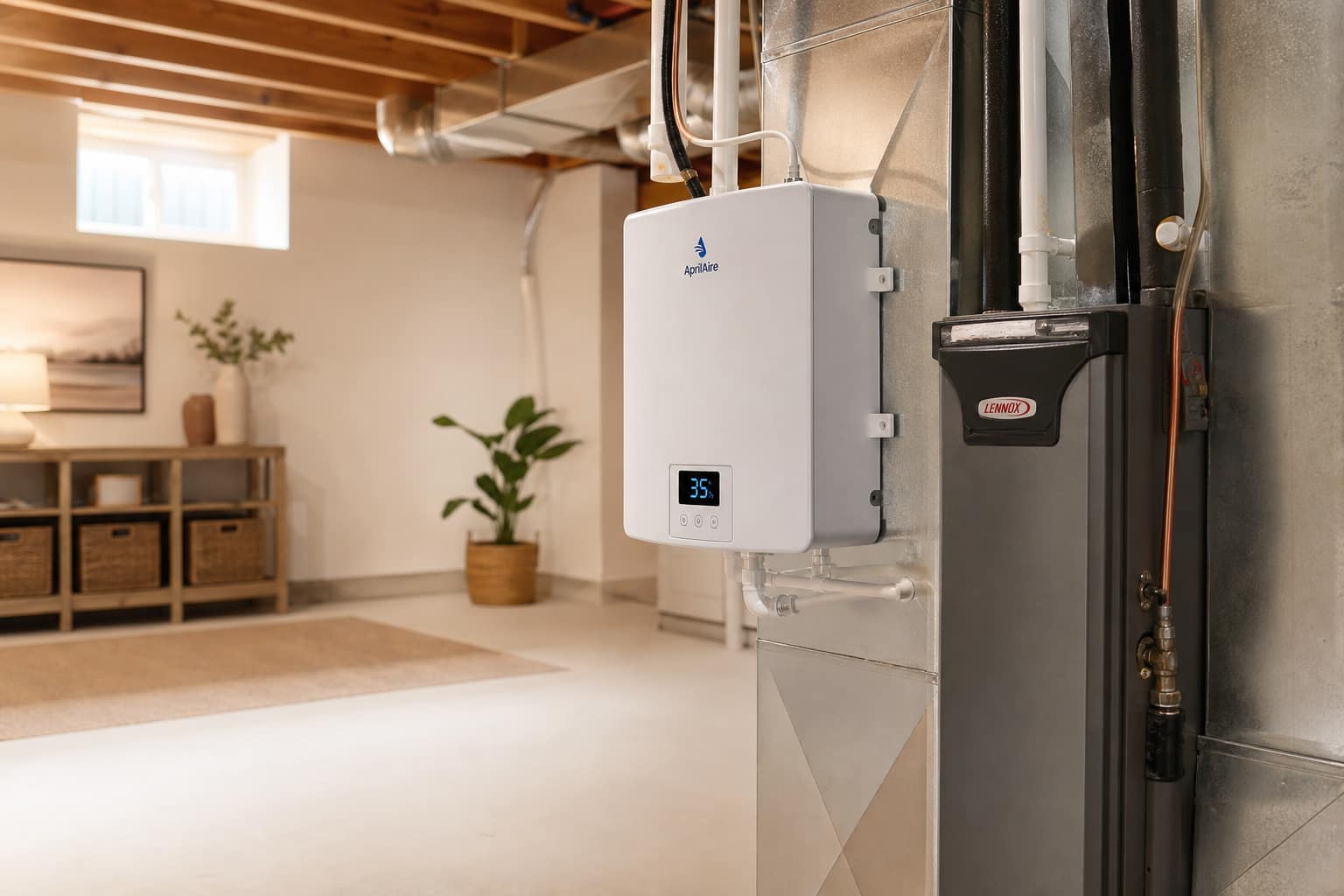
Whole-Home Humidifier Installation in DC Metro
Whole-home humidifier installation in DC Metro: bypass, fan-powered and steam units that ease dry, heated winter air.
Whole-home humidifier installation adds a humidifier to your furnace, air handler, or ductwork so it can put controlled moisture back into dry, heated winter air throughout the house. JC & JC HVAC Mechanical Contractors installs whole-home humidifiers for homes and businesses across the DC Metro area from our base in Silver Spring, MD. If winter brings static shocks, dry skin, and gapping floors, schedule a humidifier consultation and we will recommend the right type for your heating system.
Why does my house get so dry in winter?
Cold outdoor air holds very little moisture, and when it leaks indoors and is heated, its relative humidity drops sharply. A forced-air heating system circulates that dry air through every room all season long.
The DMV's winters are cold enough that heating systems run for months, and older homes in particular let in a steady stream of outdoor air through gaps around windows, doors, attics, and chimneys. Even newer homes exchange some air with the outdoors. The result is indoor humidity that can fall well below the range most people find comfortable. Many comfort guidelines point to roughly 30 to 50 percent relative humidity indoors, with the lower part of that range often better during the coldest weather to avoid window condensation. Our blog covers what indoor humidity levels are comfortable.
What are signs my home needs a whole-home humidifier?
The usual signs are frequent static shocks, dry or itchy skin, scratchy throats and sinuses in the morning, and wood floors or trim that shrink and crack. A humidity reading that stays low through the heating season confirms it.
- Static shocks from doorknobs, blankets, and light switches.
- Dry skin, chapped lips, and irritated eyes or sinuses, especially overnight.
- Gaps opening between hardwood floorboards in winter and closing in summer.
- Cracks in wood trim, cabinetry, furniture, or musical instruments.
- Rooms that feel colder than the thermostat setting, since dry air feels cooler on skin.
- Portable humidifiers that need refilling constantly and still leave the house dry.
Why not just use portable humidifiers?
Portable humidifiers can help in a single bedroom, but they need daily refilling, frequent cleaning to keep the water from growing bacteria, and one unit per room to cover a whole house. They also tend to over-humidify the room they are in while leaving the rest of the home dry. A whole-home humidifier draws from your water line, spreads moisture evenly through the ductwork, and is controlled by a single setting, so the entire house stays in a comfortable range with far less attention. There are no tanks to carry, and the unit stays out of sight next to the furnace or air handler, where it runs only when the heating system and humidity control call for moisture.
What types of whole-home humidifiers are there?
The main types are bypass humidifiers, fan-powered humidifiers, and steam humidifiers. Bypass and fan-powered units mount on the furnace ductwork and use the heating system's warmth, while steam units make their own vapor.
Bypass humidifiers
A bypass humidifier mounts on the supply or return duct and uses a small duct to route some warm air across a water panel. It has few moving parts and uses no motor of its own, which makes it simple and quiet. It works best with furnaces that produce plenty of heat in the airstream.
Fan-powered humidifiers
A fan-powered humidifier adds its own small fan to push air across the water panel, so it does not need a bypass duct. That makes it a good option where space for extra ductwork is tight, and it can deliver more moisture than a bypass unit of similar size.
Steam humidifiers
A steam humidifier boils water to create vapor and injects it into the ductwork. Because it makes its own heat, it can add moisture even when the system is circulating cooler air, which suits heat pump systems and larger homes. Steam units need more electrical capacity and periodic cleaning of the canister or chamber.
Will a humidifier work with my heat pump or furnace?
Yes, most forced-air systems can support a whole-home humidifier, but the type should match the heat source. Furnaces produce warm supply air that suits bypass and fan-powered units, while heat pumps often do better with steam.
Heat pumps deliver supply air that is warm but not as hot as a gas furnace's, so evaporative humidifiers can produce less moisture on a heat pump system. Homes with hot-water or steam boilers and no ductwork need a different approach entirely, since there is no forced air to carry the moisture. We look at your equipment, available space near the air handler, water supply, drainage, and electrical capacity before recommending a unit.
Water supply and drainage
Bypass and fan-powered humidifiers need a water supply line and, in most cases, a drain for water that runs off the panel. Steam humidifiers also need a supply and drain, plus electrical capacity for the heating element. Some homes have a convenient water line and floor drain right next to the furnace, while others need a longer run or a condensate pump. We plan these details before installation so the drainage is reliable.
Can a whole-home humidifier cause mold or condensation?
A properly controlled humidifier should not, because it adds moisture only up to a set target. Problems come from setting humidity too high, poor drainage, or skipping maintenance on the water panel or steam chamber.
A humidity control, and where suitable an outdoor temperature sensor, lets the target humidity drop automatically on the coldest days. That reduces condensation on windows and inside exterior walls. We also make sure drain lines are routed correctly so water does not collect in the furnace cabinet. Scale can form on water panels over time, and they should be replaced at least once each heating season, which is easy to fold into a fall tune-up.
Older homes, newer homes, and humidity targets
Older, draftier homes lose humidity quickly because outdoor air keeps replacing indoor air, so they often need a higher-capacity humidifier to reach a comfortable level. Tighter newer homes hold moisture better and may need only a modest unit, but they are also more prone to window condensation if the target is set too high. Matching capacity and control settings to the house prevents both problems.
Residential and commercial spaces
We install humidification in homes and in commercial spaces, where dry winter air can affect occupant comfort, wood finishes, and static-sensitive equipment.
What to expect during your visit
A humidifier installation follows a clear sequence:
- We check your current indoor humidity and talk through the dryness problems you notice.
- We inspect the furnace or air handler, ductwork, water supply, drain options, and electrical access.
- We recommend a humidifier type and size, and explain how its control will work with your thermostat.
- On installation day, we mount the unit, cut and seal duct connections, run the water line and drain, and wire the control.
- We test operation during a heating call, set the humidity target, and show you how to replace the water panel or service the steam chamber.
Installation time depends on the humidifier type and the water, drain and electrical work it needs, and we will tell you before work begins. Steam humidifiers that need a new electrical circuit involve more work than bypass or fan-powered units.
Related services
If your home is too dry in winter and too damp in summer, pair your humidifier with whole-home dehumidifier installation. Humidifiers rely on a healthy heating system, so a heating maintenance tune-up is a good time to add one. Heat pump owners may also want to schedule heat pump repair service if the system is not keeping up.
JC & JC HVAC Mechanical Contractors is family-owned, licensed, and based in Silver Spring, MD, serving residential and commercial customers throughout the DC Metro area. Our humidifier installations are backed by a 1-Year Workmanship Warranty, financing is available, and you can ask about our VIP Comfort Club maintenance plan and the Humidifier PM add-on. Call (301) 509-2475 or schedule your whole-home humidifier installation.
Available In
Frequently Asked Questions
Get answers to the most common questions about this service.
Still Have Questions?Related Services
Ready to Get Started?
Contact JC & JC HVAC to schedule your whole-home humidifier installation visit.