
How Energy Codes Affect your New Construction AC Choices
How energy codes affect your new construction AC choices is one of the most important things to understand before breaking ground on a new home. Here is a quick summary:
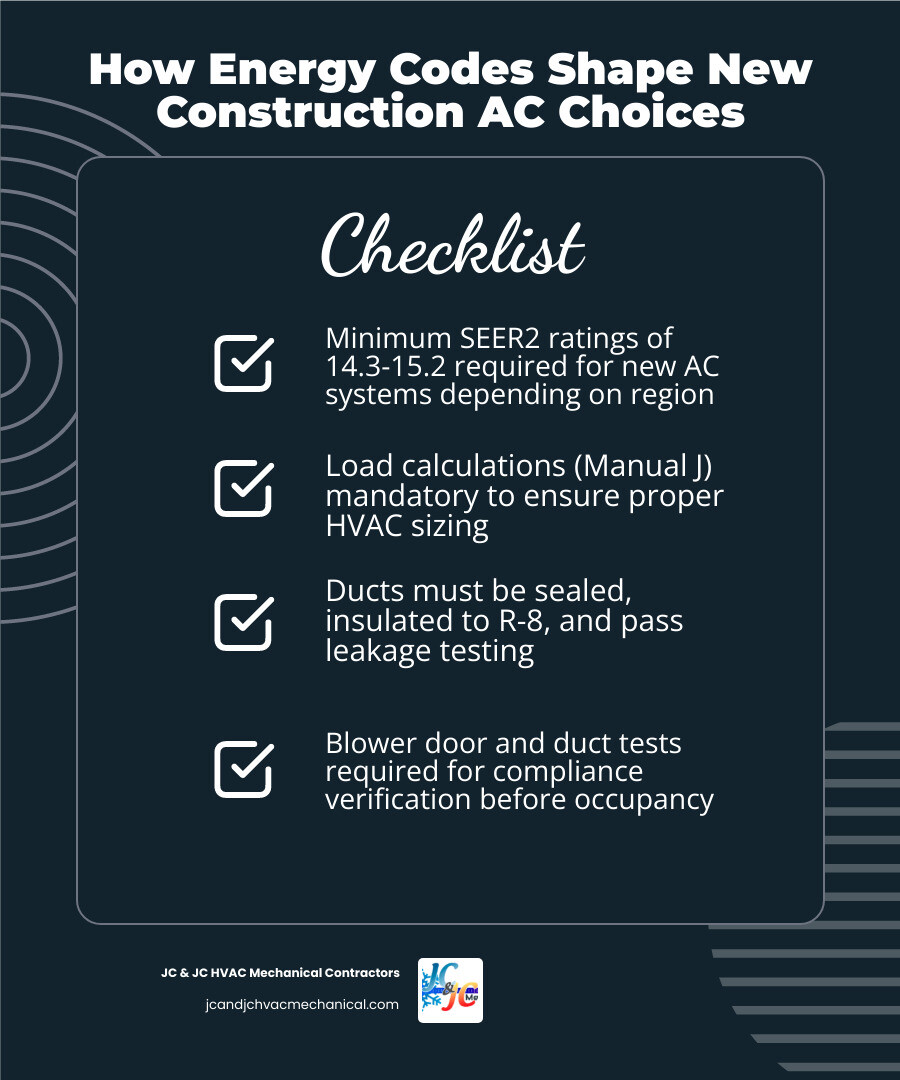
- Minimum efficiency ratings: Federal and state energy codes require new AC systems to meet minimum SEER2 ratings (14.3 to 15.2 depending on your region).
- Equipment type: In some climate zones, codes now mandate heat pumps rather than standard central AC units.
- Proper sizing: Codes require load calculations (Manual J) to prevent oversized or undersized systems.
- Ductwork standards: Ducts must meet sealing and insulation requirements, and leakage testing is mandatory.
- Compliance verification: New homes must pass inspections, blower door tests, and duct leakage tests before occupancy.
If you are building a new home in the Maryland or Washington D.C. area, these rules directly shape which AC system goes into your house — and how it performs for years to come.
Energy codes have been tightening steadily since the 1970s. Today, the 2024 International Energy Conservation Code (IECC) sets the bar higher than ever, covering everything from your attic insulation to the efficiency rating on your outdoor AC unit. Buildings account for roughly 40% of total energy consumption in the United States, which is exactly why these codes exist.
For homeowners aged 40 to 60 planning new construction in suburban Maryland or D.C., navigating these rules can feel overwhelming. But understanding the basics puts you in a much stronger position — whether you are reviewing builder contracts, asking the right questions on a job site, or simply trying to make sure your new home stays comfortable without sky-high utility bills.
This guide walks you through everything you need to know, in plain language.
Understanding How Energy Codes Affect Your New Construction AC Choices
When you build a new home, the “rules of the game” are dictated by energy codes like the International Energy Conservation Code (IECC) and standards like ASHRAE 90.1. These aren’t just suggestions; they are legal requirements that builders must follow to receive a certificate of occupancy.
In our region, including Washington, D.C., and Montgomery County, these codes have evolved from simple safety measures to complex efficiency mandates. They view your home as a “system.” This means your AC choice isn’t made in a vacuum. The thickness of your walls, the quality of your windows, and the tightness of your front door all influence everything you need to know about your new home’s comfort system.
If your building envelope (the “shell” of your house) is incredibly tight and well-insulated, the energy code might allow for a slightly different AC configuration. Conversely, if you want a specific type of high-powered cooling, the code may require you to beef up insulation elsewhere to balance the “energy budget” of the home.

Minimum Efficiency Ratings and SEER2 Mandates
One of the most direct ways how energy codes affect your new construction AC choices is through minimum efficiency ratings. You may have heard of SEER (Seasonal Energy Efficiency Ratio), but as of 2023, the industry moved to SEER2. This is a more rigorous testing standard that better reflects real-world duct pressure.
Under current energy codes, central air conditioners must meet minimum SEER2 ratings that generally fall between 14.3 and 15.2, depending on the region. For those of us in the Maryland and D.C. area, we fall into the “Northern” or “All Other” regions for some federal standards, but local codes often push these requirements even higher.
Choosing a unit that falls below these mandates simply isn’t an option for new construction. When asking what is a good SEER rating for my new AC?, the “code minimum” is just the floor. Many homeowners opt for higher ratings to ensure lower monthly bills and better dehumidification.
How Energy Codes Affect Your New Construction AC Choices Regarding Equipment Type
Energy codes are increasingly nudging—and in some cases, pushing—homeowners toward specific technologies. The biggest trend is electrification.
In many jurisdictions, the prescriptive path of the energy code now defaults to heat pumps for space heating and cooling. Heat pumps are essentially air conditioners that can “reverse” themselves to provide heat in the winter. Because they are incredibly efficient, they are the “darling” of modern energy codes.
You might also find that codes encourage variable capacity systems. Unlike old-school ACs that are either “on” or “off,” variable systems can run at 30% or 50% capacity, sipping electricity while maintaining a perfectly steady temperature. When you are trying to decide between central air and mini-split installation, energy codes may actually make the decision easier by favoring the high-efficiency performance of mini-splits or multi-zone heat pumps.
The Role of Load Calculations and Proper HVAC Sizing
In the past, some builders would use a “rule of thumb” to size AC units—perhaps one ton of cooling for every 500 or 600 square feet. Energy codes have officially banned this practice for new construction.
To comply with the code, we must perform a Manual J Load Calculation. This calculation looks at:
- The orientation of your home (which way the sun hits).
- The number and type of windows.
- Insulation levels in the attic and walls.
- Local climate data for the D.C. and Maryland area.
The goal is to find the “Goldilocks” size—not too big, and not too small. An oversized AC unit is actually a failure in the eyes of the energy code. Why? Because a system that is too large will “short cycle,” turning on and off rapidly. This fails to remove humidity, leaving you with a home that feels cold but clammy.
By following how to choose the right size HVAC unit for your home through Manual J, S (equipment selection), and D (duct design), we ensure your system meets code while providing maximum comfort.
Ductwork Design, Insulation, and Compliance Testing
You can buy the most expensive AC unit on the market, but if the ductwork is poorly designed, you’ll lose all those efficiency gains. Energy codes like the 2024 IECC place massive emphasis on the “delivery system.”
- Duct Sealing: Codes now mandate that ducts be sealed with mastic or approved tapes. The days of “duct tape” (which ironically isn’t for ducts) are over.
- Insulation: If your ducts run through an unconditioned attic, they usually require R-8 insulation to prevent the air from heating up before it reaches your bedroom.
- Conditioned Space: Many modern energy codes encourage builders to bring ducts inside the conditioned envelope of the house (e.g., between floors or in a conditioned crawlspace) to eliminate energy loss entirely.
To prove the work was done right, codes require a Duct Leakage Test. A technician will block off all the registers and use a specialized fan to pressurize the system. If too much air escapes, the builder has to find the leaks and fix them before the home passes inspection. This is a key part of the homeowners guide to choosing heating and cooling systems.
How Energy Codes Affect Your New Construction AC Choices in Different Climate Zones
The United States is divided into eight climate zones. Our service areas—including Rockville, Bethesda, and Washington, D.C.—typically sit in Climate Zone 4.
Each zone has different “prescriptive” requirements. For example, while a home in Florida (Zone 2) focuses almost entirely on cooling efficiency and humidity, a home in Maryland (Zone 4) must balance high-efficiency cooling with robust heating requirements.
State-specific variations are also common. While many states follow the IECC, others, like California with its Title 24 or Florida with its 2026 Energy Code, add their own layers of complexity. In Maryland, local counties like Montgomery or Howard may adopt the newest version of the IECC faster than other areas. Knowing the specific local “flavor” of the code is vital when determining when is the best time for AC installation during the construction phase.
| Compliance Path | Description | Flexibility |
|---|---|---|
| Prescriptive | A “checklist” approach where every component must meet a specific minimum. | Low – No trade-offs allowed. |
| Performance | Uses software to model the whole home’s energy use. | High – Better windows can “offset” a basic AC. |
| ERI (Energy Rating Index) | A score-based system (like HERS) where the lower the score, the better. | Highest – Look at the home as a total package. |
Frequently Asked Questions about Energy Codes
Building a home is a journey of a thousand questions. When it comes to how energy codes affect your new construction AC choices, here are the most common things we hear from homeowners.
Can I choose a less efficient AC through building trade-offs?
Technically, yes—if you use the Performance Path or Total UA Alternative. Energy codes allow for “trade-offs.” If you decide you want to invest heavily in “super-windows” (triple-pane, argon-filled) and R-60 attic insulation, you might be able to install an AC unit that is slightly less efficient than the prescriptive “gold standard,” provided the entire home still uses less energy than a standard code-built house.
However, with SEER2 mandates being federal law, you still cannot go below the national minimums. You are usually better off choosing a high-efficiency unit anyway to ensure you aren’t wondering when is it time to consider a heating system or AC installation just a few years down the road due to high bills.
What testing and verification processes are mandatory?
For a new home to be code-compliant, it must undergo several “stress tests”:
- Blower Door Test: This measures how many times per hour the air in your house is completely replaced by outside air. Modern codes require very “tight” houses.
- Duct Blast Test: As mentioned, this ensures your cooling air stays inside the pipes until it reaches your living room.
- Visual Inspection: Inspectors will check for things like “fire blocking” and proper insulation installation before the drywall goes up.
If your current home is drafty or has uneven temperatures, these are often 4 signs it might be time for new air conditioner installation or at least a professional energy audit to see how modern codes could improve your comfort.
Are there incentives for exceeding minimum energy codes?
Yes! “Code” is simply the legal minimum. If you choose to go beyond code, you can tap into:
- ENERGY STAR Certification: This requires higher efficiency and better testing but often comes with utility rebates.
- Federal Tax Credits: Programs like the Inflation Reduction Act offer significant credits for installing high-efficiency heat pumps.
- Zero Energy Ready Homes: A Department of Energy program for homes so efficient that a small solar array could offset all energy use.
Conclusion
Navigating how energy codes affect your new construction AC choices doesn’t have to be a headache. While the requirements for SEER2 ratings, Manual J sizing, and duct leakage testing are strict, they are ultimately designed to protect you. A code-compliant home is more comfortable, has better indoor air quality, and costs significantly less to operate over the long term.
At JC & JC HVAC Mechanical Contractors, we specialize in helping homeowners in Washington, D.C., Montgomery County, and Howard County navigate these complex regulations. Whether you are building in Bethesda, Rockville, or Silver Spring, our expert team ensures your new AC system isn’t just “to code”—it’s optimized for your family’s lifestyle.
With over 270 excellent reviews and a deep understanding of local Maryland and D.C. building requirements, we are here to ensure your new construction project is a success from the first duct to the final inspection.
Ready to plan the perfect cooling system for your new build? Contact us today for Professional AC Installation Services.