
Why Choosing the Right HVAC for New Construction Sets You Up for Decades of Comfort
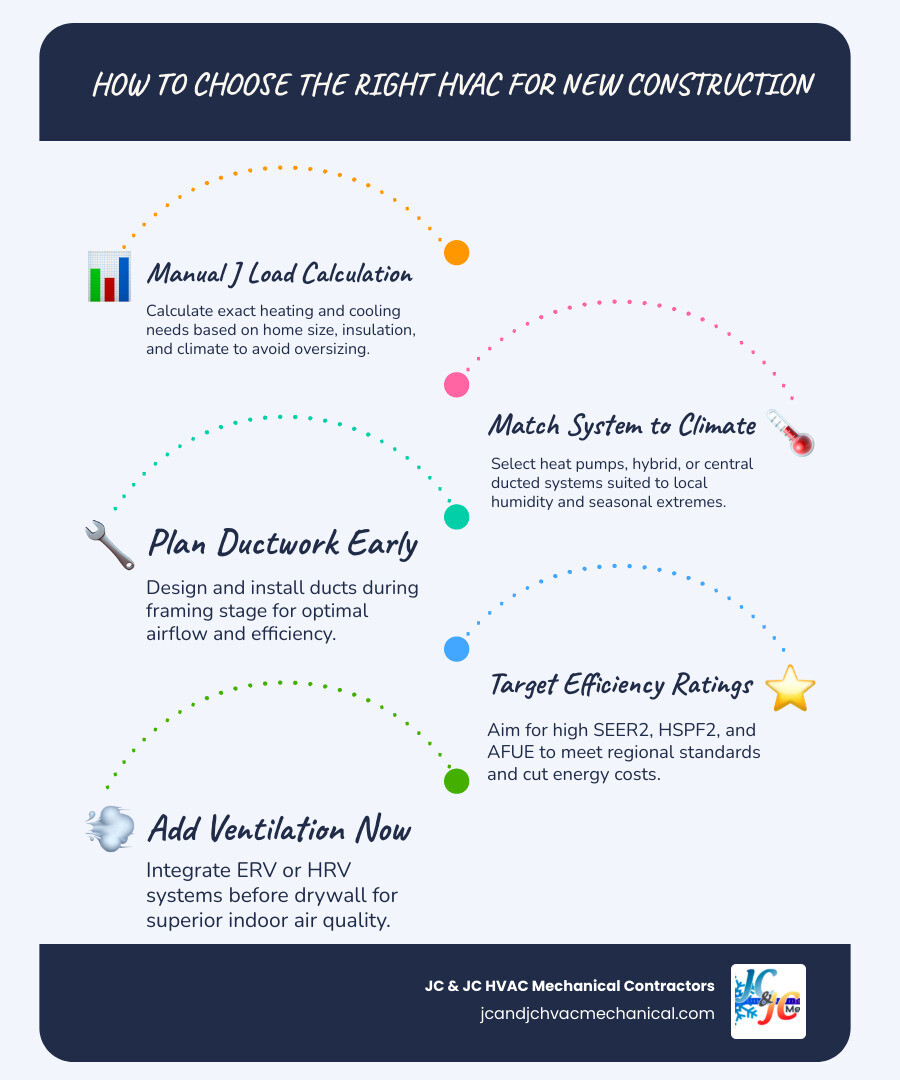
How to choose the right HVAC for new construction comes down to six core steps:
- Get a Manual J load calculation – size your system to your actual home, not a rule of thumb
- Match system type to your climate – heat pumps, hybrid systems, or central ducted based on your region
- Plan ductwork during framing – not after walls are closed
- Target the right efficiency ratings – SEER2, HSPF2, and AFUE minimums for your climate zone
- Add ventilation from the start – ERV or HRV systems are far easier to integrate before drywall
- Choose a licensed contractor with new construction experience – installation quality determines long-term performance
Building a new home in the Maryland or Washington D.C. area is one of the biggest investments you’ll ever make. But one decision that often gets less attention than it deserves — your HVAC system — will affect your comfort, your energy bills, and your indoor air quality every single day for the next 15 to 25 years.
Unlike replacing a system in an existing home, new construction gives you a rare blank slate. The ductwork, the mechanical room, the electrical capacity — all of it can be designed from scratch for peak performance. Get it right at the planning stage, and your home stays comfortable through humid Maryland summers and frigid D.C. winters without surprise breakdowns or runaway energy costs. Get it wrong, and you’re living with the consequences for decades.
About 19% of central AC systems installed between 2009 and 2024 encountered at least one problem — and nearly a quarter of those stopped working properly altogether. Most of those failures trace back to poor sizing, bad ductwork, or mismatched systems. In new construction, you have the chance to avoid every one of those mistakes before a single wall goes up.
Key Factors in How to Choose the Right HVAC for New Construction
When we sit down with homeowners in Beltsville, Rockville, or Potomac to discuss their new builds, we emphasize that an HVAC system is essentially the “lungs and circulatory system” of the home. It isn’t just about a box sitting outside; it’s about how air moves through every room. To make the best choice, we look at several essential criteria:
- Home Size and Square Footage: While total square footage is the starting point, the “5000 AC rule” (5,000 BTUs per 1,000 square feet) is just a rough estimate. New homes are often much more airtight than older ones, meaning they might actually require less raw power but more sophisticated air circulation.
- Sun Exposure and Orientation: A home with massive south-facing windows in Bethesda will have a much higher cooling load than a shaded home in Laurel. We account for how the sun hits your home at different times of the day.
- Insulation Values and Building Envelope: Are you using spray foam, rockwool, or traditional cellulose? The R-value of your walls and the quality of your windows (like triple-pane glass) drastically change the “load” or the amount of work the HVAC system has to do.
- Layout and Ceiling Height: Open-concept floor plans and vaulted ceilings create different airflow challenges compared to traditional segmented rooms. Multi-story homes almost always require a strategy for “zoning” to prevent the upstairs from becoming a sauna while the basement stays like a refrigerator.
Knowing how to pick an HVAC service company that understands these nuances is the first step in ensuring your new construction project doesn’t fall victim to “builder-grade” shortcuts that cost you more in the long run.
Understanding Climate Impact: How to Choose the Right HVAC for New Construction
Our local climate in Washington, D.C., Montgomery County, and Howard County is unique. We experience “mixed-humid” conditions. This means we have bone-chilling winters where temperatures can drop into the teens, and sweltering, humid summers where the heat index regularly clears 100°F.
Because of this, how to choose the right HVAC for new construction in our region requires a system that can handle both extremes. In moderate climates, a standard heat pump is often enough. However, in our area, many homeowners opt for hybrid systems—pairing an electric heat pump with a gas furnace backup—to ensure comfort when the Maryland frost really sets in. We also have to pay close attention to dehumidification. A system that cools the air too quickly without removing moisture will leave your brand-new home feeling clammy and “sticky.”
Comparing HVAC System Types for New Builds
In 2026, homeowners have more choices than ever. The “best” system depends on your architectural goals and your long-term energy priorities.
Central Ducted Systems
This is the traditional choice for most new builds in Germantown and Silver Spring. A central air handler distributes air through a network of ducts hidden in the floors or ceilings.
- Pros: Uniform look (just small vents), excellent air filtration, and the ability to integrate whole-home humidifiers.
- Cons: Requires significant space for ductwork; energy can be lost if ducts aren’t sealed perfectly.
Air-Source Heat Pumps
Modern heat pumps are 2 to 3 times more efficient than traditional electric heating. They don’t “create” heat; they move it from the outside air into your home (and vice versa in the summer).
- Pros: Highly efficient, provides both heating and cooling, qualifies for significant tax credits.
- Cons: Performance can dip in extreme sub-zero temperatures without “hyper-heat” technology or a backup source.
Ductless Mini-Splits
If you are building a modern home with vaulted ceilings or a “Pretty Good House” with extreme insulation, you might consider how to decide between central air and mini-split installation.
- Pros: Incredible efficiency, independent temperature control for every room, no energy loss through ducts.
- Cons: Visible indoor units on walls or ceilings; can be more expensive upfront for a whole-house setup.
Hybrid (Dual Fuel) Systems
These combine an electric heat pump with a gas furnace. The system automatically switches to gas when it becomes more efficient or necessary during deep freezes. This is a very popular choice for the D.C. metro area.
| System Type | Best For | Efficiency Rating |
|---|---|---|
| Central Ducted | Traditional layouts | SEER2 14-20+ |
| Heat Pump | All-electric/Green builds | HSPF2 8.2-10+ |
| Ductless Mini-Split | Zoned comfort/Additions | SEER2 20-30+ |
| Geothermal | Long-term luxury builds | Highest possible |
The Importance of Proper Sizing and Ductwork Design
One of the most common mistakes in new construction is sizing the system based on a “rule of thumb” (like 1 ton per 500 square feet). This almost always leads to oversizing. An oversized unit will “short-cycle,” turning on and off rapidly. This wears out the parts, fails to remove humidity, and causes annoying temperature swings.
This is why a Manual J load calculation is non-negotiable. We use specialized software to look at your home’s specific blueprints to determine the exact BTU capacity needed. Once the size is set, we use Manual D to design the ductwork.
You need to understand how to choose the right size HVAC unit for your home because once the drywall is up, fixing an undersized duct or an oversized unit is a nightmare. We see many ductwork design mistakes that experts can prevent during the framing stage, such as sharp 90-degree turns that kill airflow or crushed flex ducts in tight soffits.
Proper ductwork design ensures that the master bedroom stays just as cool as the kitchen. We prioritize keeping ducts within the “conditioned envelope” of the house—meaning they stay inside the insulated area rather than in a scorching attic—to prevent losing 20-30% of your treated air to the outside. This is a huge part of why ductwork design is so important for your monthly utility bills.
Maximizing Efficiency with Smart Technology and Ventilation
In April 2026, the standards for efficiency have reached new heights. When comparing units, you’ll see several acronyms. Don’t let them confuse you:
- SEER2: Measures cooling efficiency. The higher the number, the less electricity it uses. In our region, a SEER2 of 16-18 is a great “sweet spot” for value, though some units go as high as 26.
- HSPF2: Measures the heating efficiency of heat pumps.
- AFUE: Measures how much fuel a furnace converts to heat. A 95% AFUE furnace only wastes 5% of the gas it burns.
Knowing what is a good SEER rating for my new AC helps you balance the upfront cost with the 15-year savings. We always recommend Energy Star-certified equipment, which often exceeds federal minimums and makes you eligible for rebates.
Ventilation and Air Quality (IAQ)
Modern new homes are built “tight” to save energy. While this is great for your bills, it can be bad for your health if you don’t have a plan for fresh air. Pollutants, moisture, and odors can get trapped inside.
We recommend integrating an Energy Recovery Ventilator (ERV) or Heat Recovery Ventilator (HRV). These systems swap stale indoor air for fresh outdoor air while “recovering” the temperature so you don’t waste energy. Integrating these during construction is significantly easier than trying to add them later. We also look at high-MERV filtration and zoning controls, which allow you to use a smart thermostat to direct air only where it’s needed, saving up to 15% on energy costs.
Finalizing Your Decision: How to Choose the Right HVAC for New Construction
As we move through 2026, several regulatory shifts are affecting how to choose the right HVAC for new construction. The industry has transitioned to newer, more environmentally friendly refrigerants like R-454B and R-32, which have replaced the older R-410A. Choosing equipment designed for these new standards ensures your system won’t be obsolete in a few years.
Furthermore, the Inflation Reduction Act continues to provide significant tax credits for high-efficiency heat pumps and geothermal systems. We can help you navigate these incentives to ensure you’re getting the most “bang for your buck.” Future-proofing also means considering modular upgrades—choosing a furnace or air handler that is “solar-ready” or compatible with future smart-grid technologies.
Frequently Asked Questions about New Construction HVAC
Why is a Manual J calculation essential for new homes?
A Manual J calculation is the only way to accurately size a system. If you guess and install a unit that is too large, it will short-cycle, leading to high humidity and premature mechanical failure. If it’s too small, it will run constantly and never keep you comfortable. Understanding how to choose the right size HVAC unit for your home starts with this data-driven approach.
Should I choose ducted or ductless for my new build?
It depends on your home’s design. Ducted systems are great for a seamless look and whole-home filtration. Ductless systems offer superior zoning and are often easier to install in homes with complex rooflines or slab-on-grade foundations. You can read more about how to decide between central air and mini-split installation to see which fits your lifestyle.
How do I integrate air quality features during construction?
The best way is through air duct installation design that includes dedicated returns for an ERV and space in the mechanical room for a whole-home dehumidifier or high-efficiency air cleaner. This ensures your home isn’t just the right temperature, but also has healthy, breathable air.
Conclusion
Choosing the right HVAC system is one of the most impactful decisions you will make during your new construction project. From the initial load calculations to the final commissioning of the unit, every step requires precision and expertise.
Before you sign off on your mechanical plans, ask your installer these questions:
- Did you perform a Manual J load calculation based on my specific insulation and window specs?
- Is the ductwork designed to stay within the conditioned space of the home?
- What is the SEER2 and HSPF2 rating of the proposed equipment?
- How will the system provide fresh air ventilation (ERV/HRV)?
- What is the warranty on both the parts and the labor?
At JC & JC HVAC Mechanical Contractors, we take pride in helping homeowners across Washington, D.C., Montgomery County, and Howard County build homes that are efficient, comfortable, and healthy. With over 270+ excellent reviews, our expert team is ready to provide the professional installation and preventive maintenance your new investment deserves.
Ready to ensure your new home is built for comfort? Contact our expert team for your new construction project today for a consultation in Beltsville, Rockville, Bethesda, or anywhere in our service area. We’re here to help you get it right from day one.