
Why AC Making Strange Noises What They Mean Matters More Than You Think
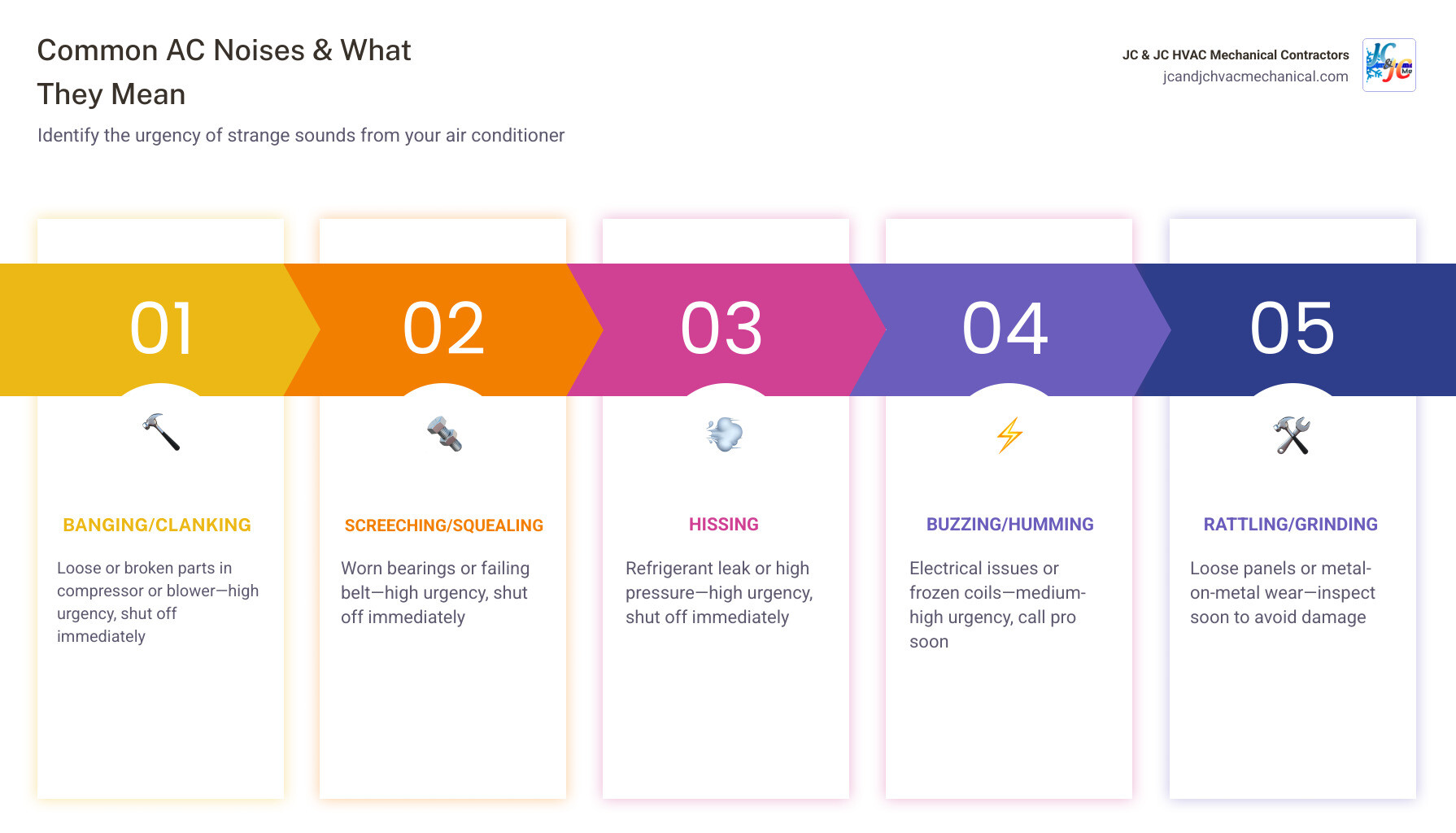
If ac making strange noises what they mean is the question running through your head right now, here is a quick answer: most unusual AC sounds are your system signaling that something is wrong — and the specific sound usually points to a specific problem.
| Sound | Most Likely Cause | Urgency |
|---|---|---|
| Banging / Clanking | Loose or broken part inside compressor or blower | High — shut off immediately |
| Screeching / Squealing | Worn motor bearings, failing belt, or high compressor pressure | High — shut off immediately |
| Hissing | Refrigerant leak or high internal pressure | High — shut off immediately |
| Buzzing / Humming | Electrical issue, faulty capacitor, or frozen evaporator coil | Medium-High — call a pro soon |
| Clicking (repeated) | Failing relay, contactor, or thermostat issue | Medium — schedule inspection |
| Whistling | Dirty air filter or blocked vents restricting airflow | Low-Medium — check filter first |
| Rattling | Loose panel, debris in unit, or worn fan motor | Low-Medium — inspect soon |
| Bubbling / Gurgling | Clogged condensate drain or refrigerant leak | Medium — schedule service |
| Grinding | Worn motor bearings causing metal-on-metal contact | High — shut off immediately |
Modern AC systems are designed to run quietly — typically between 25 and 55 decibels, about the volume of a quiet conversation. Some high-efficiency indoor units operate as low as 19 decibels, which is quieter than a whisper. When your system suddenly sounds like something out of a horror movie, it is not just annoying. It is a warning.
The tricky part is that not every noise means the same thing. A soft hiss right after your AC shuts off can be completely normal — that is just refrigerant pressure equalizing. But a loud, persistent hiss while the system is running is a different story entirely, and could point to a refrigerant leak that poses real health risks including headaches and respiratory issues. Knowing the difference is what separates a quick, inexpensive fix from a full system breakdown.
For homeowners in the Maryland and Washington D.C. area, where summer humidity and heat push AC systems hard, catching these audio warning signs early can be the difference between a simple repair and a costly emergency replacement.
Distinguishing Normal Hum from Problematic Sounds
Before we dive into the scary stuff, let’s talk about what is normal. In April 2026, air conditioning technology has reached a point where systems are incredibly stealthy. You should expect a gentle hum when the unit is running and a soft “whoosh” of air coming through your vents. You might also hear a single click when the cycle begins or ends—this is just the thermostat relay doing its job.
However, when a noise changes pitch, gets louder over time, or starts to vibrate the walls, that is your signal to investigate. A normal hum allows for a quiet conversation right next to the unit. If you find yourself shouting over your AC, or if the sound is rhythmic and jarring, it has moved from “normal operation” to “problematic sound.”
| Normal Sound | What It Is | Abnormal Sign |
|---|---|---|
| Soft Hum | Compressor/Fan running | Loud Buzzing or Grinding |
| Air Whoosh | Air moving through ducts | Whistling or Wheezing |
| Single Click | Relay switch engaging | Rapid, persistent clicking |
| Brief Hiss (at stop) | Pressure equalizing | Constant hissing while running |
Banging, Clanking, and Screeching: Mechanical Emergencies
When your air conditioner starts making heavy metal-on-metal sounds, we consider this a mechanical emergency. These noises typically mean something has come loose or is physically breaking inside the unit. Ignoring these is the fastest way to turn a repair into a total system replacement.
If you notice these sounds, the best first step is to review 8 Signs That It Might Be Time For Ac Repair to see if other symptoms are present.
What clanking or banging noises from an AC unit signify when your ac making strange noises what they mean
Banging and clanking are usually the sounds of a “loose part” drama playing out inside your system. If the sound is coming from the outdoor unit, it often indicates a problem with the compressor—the heart of your AC. It could be a broken piston pin, a loose connecting rod, or a crankshaft issue. Because the compressor is a sealed unit, these internal breaks often mean the whole compressor needs to be replaced.
If the clanking is coming from your indoor unit, it is likely the blower assembly. The blower fan might be out of balance and hitting the protective housing, or the motor mounts may have failed, allowing the whole assembly to rattle around. This is a high-priority issue. If you are in the city, our Air Conditioning Services/Ac Repair Service Washington Dc team can help stabilize these components before they cause catastrophic damage to the rest of the system.
Screeching, Squealing, and Grinding: Worn Bearings and High Pressure
Screeching and squealing are enough to make anyone’s hair stand on end. These high-pitched sounds are often compared to nails on a chalkboard.
- Worn Fan Belt: In older systems, a squealing sound often points to a fan belt that has slipped or is frayed. High humidity in areas like Silver Spring or Bethesda can cause these belts to expand and contract, leading to that signature scream.
- Motor Bearings: If you hear a grinding sound, it almost always means the bearings in your fan motor or blower motor have dried out or worn down. This metal-on-metal contact will eventually burn out the motor entirely.
- High Compressor Pressure: This is the most dangerous cause. A high-pitched whistling or screaming that lasts for 10 to 15 seconds right as the cooling cycle begins can indicate dangerously high internal pressure in the compressor.
If your system is screaming, shut it down immediately. For those in Montgomery County, our technicians providing Air Conditioning Services/Ac Repair Service Bethesda Md have the specialized tools to check these pressure levels safely.
Rattling and Chirping: Loose Components and Debris
Not every noise is an emergency, but they all deserve a look. Rattling is often a “surface-level” problem. It might be as simple as loose panel screws vibrating against the metal casing. However, it can also be caused by debris. Twigs, leaves, or small stones can fall into the outdoor condenser unit, where the fan picks them up and bats them around like a pinball machine.
Chirping is a unique sound—often described as a light, repetitive squeak. While it is usually less serious than a bang, it typically points to dry bearings or a belt that is just starting to fail. If you hear this in Silver Spring, checking in with Air Conditioning Services/Ac Repair Service Silver Spring Md can help you catch the problem before that chirp turns into a full-blown screech.
Buzzing, Hissing, and Whistling: Electrical and Airflow Issues
While mechanical sounds are about things hitting each other, buzzing and hissing are often about things escaping—whether that is electricity or refrigerant. These issues can be harder to see but are just as critical to address.
What causes a hissing sound in an AC and what action should be taken regarding ac making strange noises what they mean
A persistent hissing sound is almost always the sound of a refrigerant leak. Refrigerant is a high-pressure chemical; when it escapes through a tiny crack in the coils or lines, it makes a “snake-like” hissing or whistling sound.
This is not just a performance issue. Refrigerant leaks are health hazards and can cause:
- Respiratory issues
- Severe headaches
- Nausea or vomiting
If you hear hissing, it could also be an internal valve or the compressor’s pressure relief system. In either case, the action is the same: turn the system off. Refrigerant repairs must be handled by EPA-certified professionals. If you are feeling the heat, Hot Enough For You Our Air Conditioning Repair Service Can Help restore your safety and comfort. You can also learn more about why these leaks happen by reading about Need Ac Repair Here Are Five Common Problems.
Buzzing, Humming, and Clicking: Electrical Relays and Frozen Coils
Buzzing is the “electrical” warning light of the HVAC world.
- Electrical Issues: Buzzing can mean a contactor relay is failing, a capacitor is struggling to start the motor, or there is electrical arcing from loose wiring.
- Frozen Coils: Interestingly, buzzing from the indoor unit often means your evaporator coils have frozen over. This happens when airflow is restricted or refrigerant is low. If you are wondering Why Is My Ac Freezing Up, a buzzing sound is a major clue.
- Isolation Feet: On the outdoor unit, the compressor sits on small rubber mounts called isolation feet. If these crack or harden, the compressor’s natural vibration turns into a loud, annoying buzz.
Clicking is normal once, but repeated clicking is a problem. It usually means the thermostat is trying to tell the AC to turn on, but the electrical components aren’t responding. It’s like a car that won’t start—you hear the click, but no engine roar.
Whistling, Bubbling, and Gurgling: Airflow Restrictions and Drain Clogs
If your AC sounds like it is finishing a soda through a straw, you are hearing gurgling or bubbling. This usually points to one of two things: a refrigerant leak (where air bubbles are mixing with the liquid) or a clogged condensate drain line. When the drain line is partially blocked, the water “glugs” as it tries to escape, which can eventually lead to water damage in your home.
Whistling, on the other hand, is usually an “airflow” scream. A whistling sound—often called the “tea kettle effect”—is frequently caused by a dirty air filter that is so clogged the fan is literally whistling as it tries to suck air through the tiny remaining gaps. It can also mean your vents are blocked or your ductwork has a leak. For more on these types of issues, check out our general guide on Air Conditioning Services/Ac Repair.
Troubleshooting and Preventing a Noisy AC Unit
Not every noise requires a technician right away. Sometimes, a little homeowner TLC can silence the “ghosts” in your vents. However, safety is paramount. Always turn off the power at the thermostat and the circuit breaker before inspecting your unit.
Simple Troubleshooting Steps for Homeowners
If your AC is making strange noises, try these steps before calling for backup. For more detailed DIY tips, see Ac Fixes When You Dont Need Air Conditioner Service Or Ac Replacement.
- Check the Filter: A whistling or buzzing AC is often just a hungry AC. Replace your filter every 1–3 months to ensure proper airflow.
- Clear the Debris: Turn off the power and look inside your outdoor unit. If you see twigs or leaves, carefully remove them. Ensure there is at least two feet of clear space around the unit.
- Tighten the Panels: If you hear a rattle, use a screwdriver to ensure all the exterior panel screws are snug. Sometimes the vibration of the unit just loosens them over time.
- Inspect the Vents: Ensure at least 80% of your home’s vents are open and unblocked by furniture or curtains. Closed vents increase pressure and noise.
How Regular Maintenance Prevents Strange AC Noises
The secret to a quiet air conditioner is regular maintenance. Most of the scary noises we’ve discussed—screeching bearings, clanking fans, and buzzing electrical components—can be prevented with a seasonal tune-up.
During a professional maintenance visit, we:
- Lubricate Moving Parts: This prevents the metal-on-metal grinding that leads to motor failure.
- Clean the Coils: Clean coils prevent the system from straining and vibrating.
- Tighten Electrical Connections: This stops the buzzing and prevents potential fire hazards.
- Check Refrigerant Levels: We catch tiny leaks before they become hissing emergencies.
- Inspect Belts: We tension or replace worn belts before they start squealing.
Frequently Asked Questions about AC Noises
Is it safe to run my AC if it is making a loud banging noise?
No. A loud banging or clanking noise usually means a metal part has come loose or broken inside the compressor or blower assembly. Continuing to run the unit can cause “catastrophic damage,” turning a repair into a full system replacement. Shut the unit off immediately and call a professional.
Why does my air conditioner make noise after it shuts off?
Some noise is normal for 1 to 2 minutes after shutdown. You might hear the ductwork “pop” as the metal contracts from temperature changes, or a brief hiss as the refrigerant pressure equalizes. However, if you hear loud banging or a persistent buzz after the system stops, it could indicate a failing compressor mount or an electrical relay issue.
Can a dirty air filter cause my AC to make strange sounds?
Absolutely. A clogged filter restricts airflow, which causes the blower motor to work harder (leading to thumping or humming). It also creates a “whistling” sound as air is forced through small gaps and can even cause the evaporator coils to freeze, resulting in a loud buzzing sound.
Conclusion
Your home should be a place of peace and quiet, not a haunted house of clunks and screams. Understanding ac making strange noises what they mean is the first step in protecting your investment and your comfort. Whether you are dealing with a minor rattle in Germantown or a mechanical emergency in Washington D.C., ignoring these sounds is never the answer.
At JC & JC HVAC Mechanical Contractors, we bring expert diagnosis and professional service to every call. With over 270 excellent reviews and a commitment to 24/7 emergency services, we are here to ensure your system runs as quietly as a whisper. We serve Beltsville, Rockville, Potomac, Silver Spring, Bethesda, Laurel, Germantown, and the greater Washington D.C. area.
Don’t let a noisy AC ruin your summer. If your system is trying to tell you something, we are here to listen and fix it. Contact us today for all your Air Conditioning Services and get back to the “Symphony of Silence” you deserve.