
Why Ductwork Design Decisions for New Construction AC Systems Make or Break Your Home’s Comfort
Ductwork design decisions for new construction ac are one of the most consequential choices you’ll make when building a home — yet they’re almost always the most overlooked. Most homeowners focus on the HVAC unit itself: the brand, the efficiency rating, the warranty. But even the most advanced system will fail to deliver comfort if the ductwork carrying its air is poorly planned.
Here’s a quick summary of the key decisions to get right from the start:
- Perform a Manual J load calculation — room by room, not just by square footage
- Select equipment using Manual S — sized to actual heating and cooling loads
- Design ducts using Manual D — sizing each run based on required CFM and friction rate
- Choose the right layout — trunk-and-branch or radial, based on your floor plan
- Select appropriate materials — rigid metal for main trunks, flex only for short branch runs
- Plan return air ducts carefully — undersized returns starve the blower and hurt air quality
- Seal and insulate all ductwork — especially in attics and crawlspaces, to meet code and prevent energy loss
- Test before you close the walls — duct leakage testing is code-required in most jurisdictions
Research shows that improper ductwork is responsible for comfort problems in roughly 9 out of 10 HVAC jobs. That’s not a small margin. An unsealed or poorly designed duct system can lose up to 30% of conditioned air before it ever reaches a living space. In a brand-new home in the Maryland and Washington D.C. area, where summers are humid and winters are cold, that kind of waste hits you in comfort and in energy bills.
The good news? When ductwork is engineered correctly from the start — using proven standards and real load data — your system runs quieter, lasts longer, and keeps every room consistently comfortable. This guide walks you through every major decision so you know exactly what to ask for and what to expect.
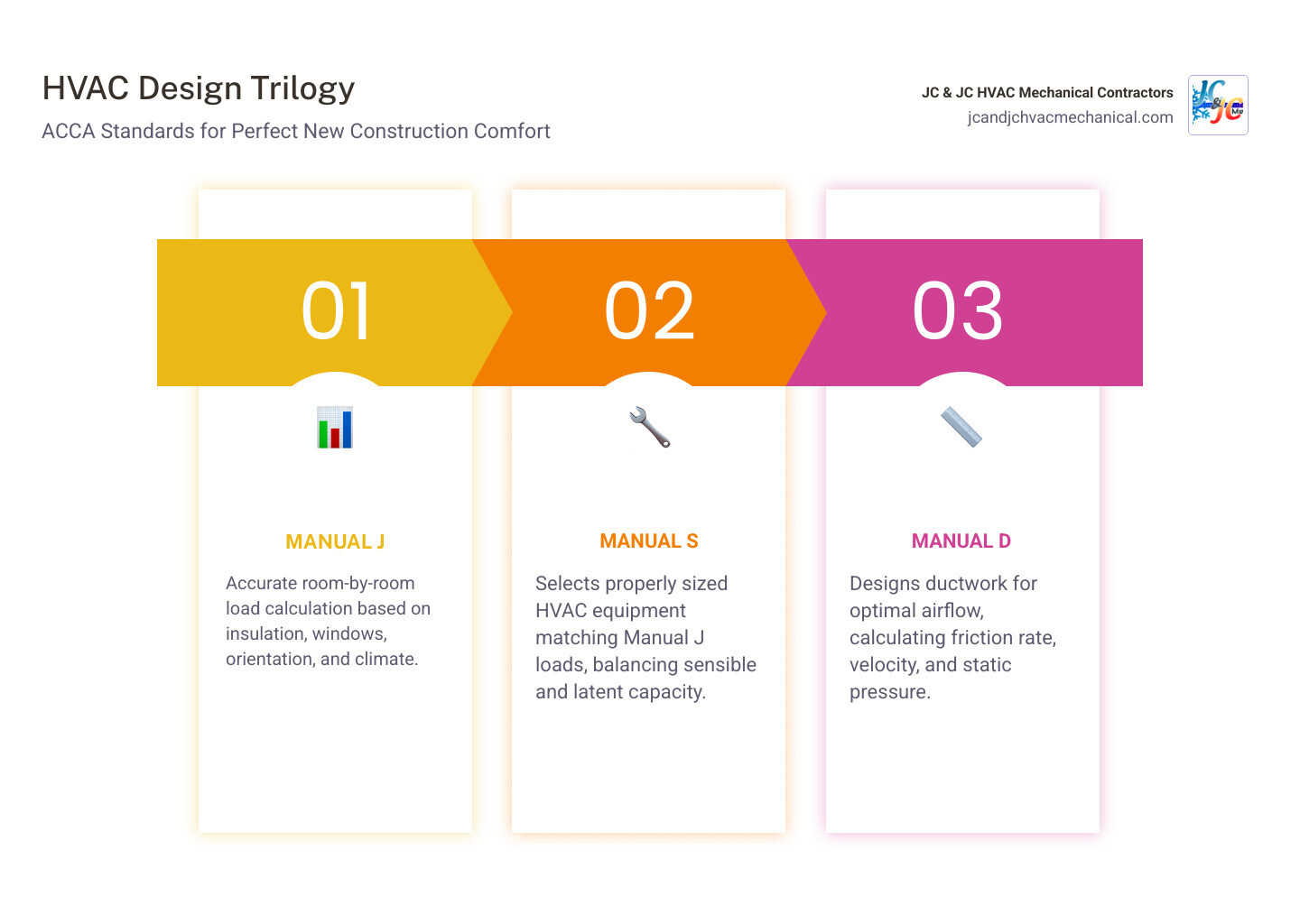
The HVAC Trilogy: Manual J, S, and D Standards
In professional HVAC engineering as of April 2026, we don’t guess; we calculate. The industry recognizes a specific “trilogy” of standards created by the Air Conditioning Contractors of America (ACCA) that ensures your new home in Silver Spring or Bethesda feels exactly the way it should.
Manual J: The Load Calculation
Before we even look at a duct, we have to know how much “work” the system needs to do. A Manual J calculation determines the heating and cooling load for every single room. We look at the home’s orientation (which way does the sun hit those big windows in Potomac?), the R-value of your insulation, and even the number of people who will live there.
A common industry mistake is using “rules of thumb” like square footage alone. This is dangerous because modern, energy-efficient homes in Rockville or Germantown require much less cooling than older builds. If you over-size the unit, it will “short cycle,” turning on and off so fast that it never removes the Maryland humidity.
Manual S: Equipment Selection
Once we know the load, we use Manual S to pick the right machine. This goes beyond just “tonnage.” We look at “sensible” heat (temperature) and “latent” heat (humidity). In our humid D.C. climate, moisture removal is just as important as cooling the air. How To Choose The Right Size HVAC Unit For Your Home is a critical step because the blower’s capacity determines how much air the ducts must be able to move.
Manual D: Duct Sizing
Manual D is where the magic happens. It takes the airflow requirements from Manual J and the equipment specs from Manual S to determine the exact size and path of every duct. It ensures that the room at the far end of your Laurel home gets just as much air as the room right next to the furnace. Following HVAC Ductwork Principles Your Contractors Should Know ensures that your system doesn’t sound like a jet engine every time the AC kicks on.
Key Ductwork Design Decisions for New Construction AC Performance

When we sit down to plan Ductwork Design Washington DC, we are essentially managing “pressure.” Think of your ducts like the circulatory system in your body. If the “blood pressure” (static pressure) is too high, the “heart” (the blower motor) has to work too hard and will eventually fail.
Understanding Static Pressure and Friction Rate
External Static Pressure (ESP) is the resistance the blower must overcome to move air through the filters, coils, and ducts. If the ducts are too small, the static pressure skyrockets.
We calculate the Friction Rate to determine how much pressure is lost over every 100 feet of ductwork. A well-designed system typically targets a friction rate of 0.08 to 0.10 inches of water column. If we reduce that friction rate to 0.05, we might use slightly larger ducts, but we can cut fan energy usage by 15% to 20%. This is Why Ductwork Design Is So Important—it directly impacts your monthly utility bill for the next 20 years.
Total Effective Length (TEL)
A duct isn’t just a straight line. Every elbow, tee, and register adds resistance. We use “Equivalent Lengths” for these fittings. For example, a sharp 90-degree elbow might “feel” like 30 feet of straight pipe to the air moving through it. By using gradual radius elbows instead of sharp turns, we keep the TEL low and the airflow high.
Velocity Limits and Noise
Nobody wants to turn up the TV volume just because the AC started. To prevent noise, we keep air velocity within specific limits:
- Supply Trunks: 700–900 feet per minute (fpm)
- Branch Ducts: 500–700 fpm
- Return Ducts: 400–700 fpm
Keeping velocities low ensures a whisper-quiet home while maintaining the necessary “throw” to mix the air in each room properly.
Strategic Ductwork Design Decisions for New Construction AC Airflow
The biggest mistake we see in new construction is “starving” the system of air. For every cubic foot of air we blow into a room, we must take one out. This is why A Deep Breath Into Ductwork Design And Airflow focuses so heavily on the return side of the system.
- Central vs. Distributed Returns: A central return (one big vent in the hallway) is cheaper but can lead to pressure imbalances when bedroom doors are closed. Distributed returns (a vent in every room) provide the best comfort and privacy.
- Pressure Relief: If you don’t have a return in every room, we use jump ducts or transfer grilles to ensure air can get back to the unit even when doors are shut. This prevents The Indicators Of Ineffective Ductwork Design, such as hot spots and whistling doors.
Common Layout Configurations
- Extended Plenum: A large main trunk that stays the same size for its entire length. It’s simple to install but can have lower pressure at the very end.
- Reducing Trunk: The trunk gets smaller as it goes, maintaining constant pressure and velocity. This is the gold standard for performance.
- Radial System: Every room has its own dedicated run from a central “spider” plenum. This is great for smaller, single-story homes in areas like Beltsville.
Optimizing Ductwork Design Decisions for New Construction AC Efficiency
Modern Air Duct Installation Design should take advantage of 2026 technology.
- Zoning Systems: Why cool the guest bedrooms during the day when everyone is in the home office? Zoning allows us to use dampers to direct air only where it’s needed.
- Variable Speed Blowers: These motors can adjust their speed based on the static pressure and demand. They are much more efficient than traditional “on/off” motors but require perfectly sized ducts to function correctly.
- Energy Recovery Ventilators (ERVs): Since new homes in Maryland are built so tight, we need to bring in fresh air. An ERV swaps the heat and humidity between the outgoing stale air and incoming fresh air, keeping your IAQ high without wasting energy.
- Smart Thermostat Integration: When we design your system, we ensure the ductwork can handle the varying loads that smart thermostats demand.
If you are torn between traditional ducts and other options, checking How To Decide Between Central Air And Mini-Split Installation can help you decide if a ducted system is truly the best fit for your specific floor plan.
Selecting Materials and Layout Configurations
The materials we choose for your Ductwork affect everything from airflow resistance to indoor air quality.
| Feature | Round Metal | Rectangular Metal | Flexible Duct |
|---|---|---|---|
| Airflow Efficiency | Excellent (Lowest friction) | Good | Fair (If pulled tight) |
| Space Required | High (Harder to hide) | Low (Fits in joists) | Moderate |
| Noise Control | Good | Fair (Can “oil can”) | Excellent |
| Durability | High | High | Low |
| Cost | Moderate | High | Low |
Rigid Metal vs. Flex
We generally recommend galvanized steel for all main trunk lines. It is durable, easy to seal with mastic, and offers the least resistance. Flexible ducting has its place — specifically for the last few feet of a run to a register to help dampen noise — but it must be pulled taut. A sagging flex duct can increase resistance by 50% or more.
Aspect Ratios and the Wetted Perimeter
In rectangular ducts, we try to keep the “aspect ratio” (width vs. height) as close to 1:1 or 2:1 as possible. A flat, wide duct (like 24×6) has a much larger “wetted perimeter” than a square one. More surface area means more friction, which means less air reaching your rooms.
Support and Reinforcement
We follow SMACNA standards for all installations. This means using proper hangers spaced correctly to prevent sagging and vibration. A well-supported system is a quiet system.
Installation Standards and Code Compliance
Building codes in Washington D.C. and Maryland have become much stricter regarding ductwork, and for good reason.
Sealing with Mastic
Tape eventually fails. We use “mastic,” a thick, gooey sealant that hardens to create an airtight bond. We seal every joint, from the plenum to the register boot. Duct leakage is often the primary reason for high energy bills.
Insulation and Placement
If ducts are located in an unconditioned attic, they must be insulated to at least R-8. However, the best ductwork design decisions for new construction ac involve keeping the ducts entirely within the “conditioned space” of the home (e.g., between floors or in a dropped soffit). When ducts are inside the thermal envelope, any small leak stays inside the house rather than heating the squirrels in your attic.
Duct Leakage Testing
In most of our service areas, including Montgomery County, code requires a duct leakage test. We block off all registers and use a specialized fan to pressurize the system. For new construction, total leakage should generally be ≤ 8 cfm per 100 square feet of conditioned floor area.
Avoiding Ductwork Design Mistakes That Experts Can Prevent during the rough-in phase saves you from massive headaches later. If you’re wondering, Should I Insulate My Old Ducts Or Install New Ones?, the answer for a new build is always to do it right the first time with high-quality insulation and vapor barriers to prevent condensation.
Frequently Asked Questions about Ductwork Design
What happens if my new construction ducts are undersized?
Undersized ducts are a disaster for your HVAC system. They cause high static pressure, which leads to:
- Excessive Noise: Air whistling through small openings.
- System Strain: The blower motor has to run at max speed, shortening its life.
- Uneven Temps: The air simply can’t reach the furthest rooms.
- Freezing Coils: In the summer, low airflow can cause the AC evaporator coil to turn into a block of ice, potentially killing your compressor.
Which is better for new builds: rigid metal or flexible ducts?
We prefer a hybrid approach. Rigid galvanized steel should be used for the main trunks and the primary branches for maximum efficiency and durability. Flexible ducting is useful for the final “run-out” (usually 5–6 feet) to the register because it’s easier to install around framing and helps absorb mechanical noise from the unit. However, overusing flex duct is a recipe for poor airflow.
Why is return air design so critical in modern homes?
Modern homes are built to be airtight. In an old, drafty house, air could find its way back to the furnace through cracks. In a new build in Rockville or Silver Spring, if you don’t provide a clear path (a return duct), the room becomes pressurized. The supply air literally can’t enter the room because there’s nowhere for the existing air to go. This “starves” the blower and leads to poor indoor air quality and high energy costs.
Conclusion
Making the right ductwork design decisions for new construction ac is about looking at your home as a complete system. It’s not just about the box outside; it’s about the “veins and arteries” that allow that box to do its job. By adhering to Manual J, S, and D standards and focusing on quality materials and sealing, you ensure that your home remains a sanctuary of comfort for decades to come.
At JC & JC HVAC Mechanical Contractors, we’ve built our reputation on expert, professional service—just look at our 270+ excellent reviews. Whether you are building in Washington D.C., the heart of Montgomery County, or Howard County, our team has the local expertise to engineer a system that meets the high standards of April 2026.
Ready to ensure your new build has the perfect airflow? From initial design to the final AC Installation, we are here to help. Contact us today to discuss your new construction project in Beltsville, Bethesda, or anywhere in our service area.