
Are Heat Pumps Efficient in Four Season Climates? Here’s What MD/DC Homeowners Need to Know
Are heat pumps efficient in four season climates? Yes — and the data backs it up. Modern heat pumps deliver reliable heating and cooling across all four seasons, including the cold, snowy winters and hot, humid summers common in the Maryland and DC suburbs. If you’ve been on the fence about switching from a traditional furnace-and-AC setup, here’s a quick look at why heat pumps work so well in variable climates:
- Heating efficiency: Heat pumps produce 2–3 units of heat for every unit of electricity consumed — even in cold weather
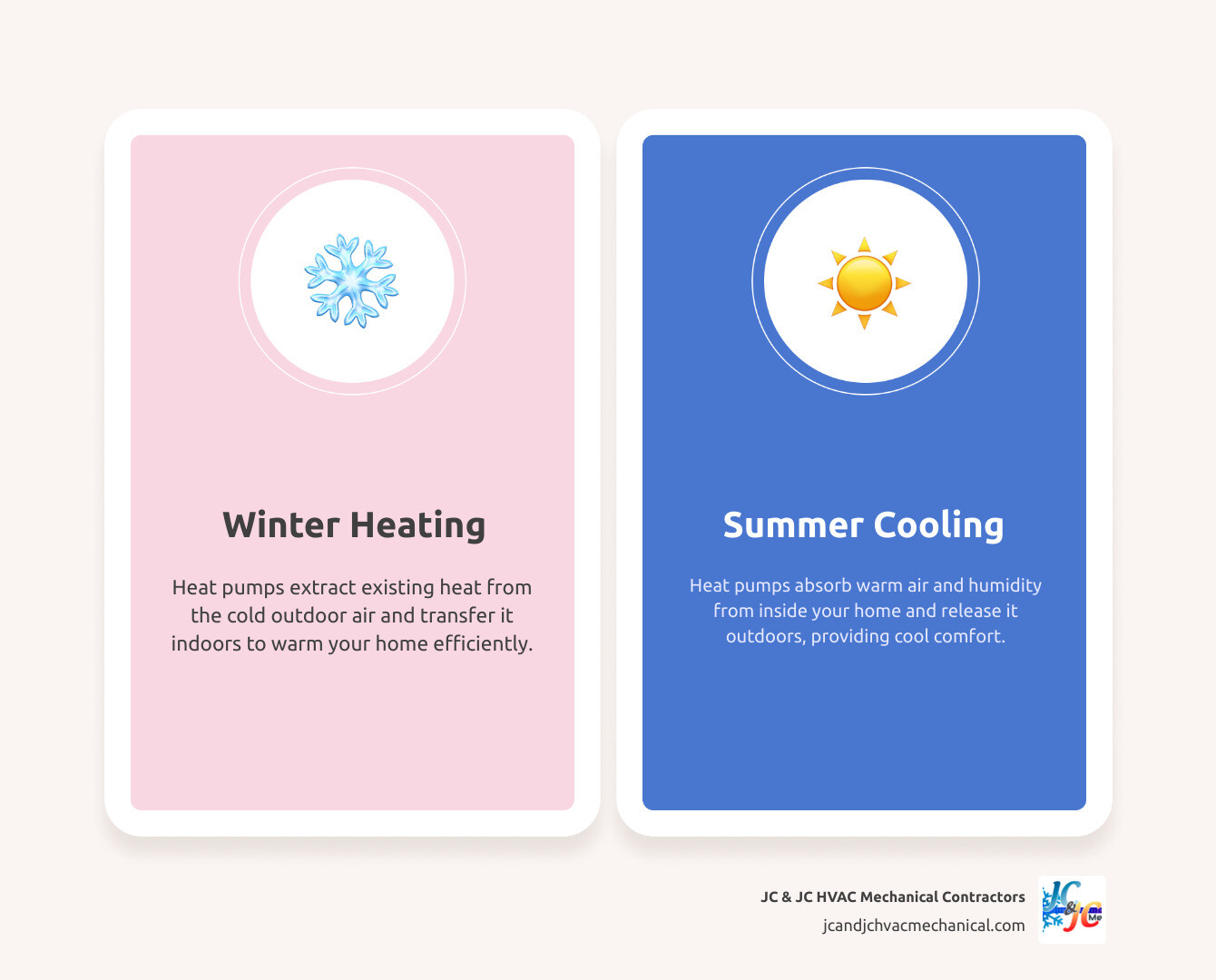
- Cooling efficiency: The same system that heats your home in winter cools and dehumidifies it in summer
- Cold weather capability: Cold-climate models are designed to operate effectively at temperatures as low as 5°F
- Energy savings: Switching to a heat pump can reduce your electricity use for heating by up to 75% compared to electric resistance heating
- Year-round reliability: A properly installed heat pump handles the full swing of Mid-Atlantic weather without needing separate systems
For the suburban MD/DC homeowner dealing with furnace failures in January and sticky, uncomfortable summers in July, that kind of versatility matters. Old assumptions about heat pumps struggling in cold weather are based on older technology. Today’s systems — especially cold-climate and variable-speed models — are a different story entirely.
A 2024 study by the National Renewable Energy Laboratory found that when federal subsidies are factored in, 90% of households that replaced older heating systems with newer heat pumps saw lower energy costs. Even without subsidies, up to 59% of U.S. households came out ahead on energy bills.
The bottom line: heat pumps aren’t just for mild climates anymore.
Are Heat Pumps Efficient in Four Season Climates?
When we talk about the Mid-Atlantic region—from the busy streets of Washington DC to the quiet suburbs of Rockville and Potomac—we are talking about a true four-season climate. We see everything from bone-chilling February freezes to the “code red” humidity of August. To understand why people ask are heat pumps efficient in four season climates, we have to look at how these systems are rated.
Efficiency in a heat pump is measured by three main metrics:
- SEER2 (Seasonal Energy Efficiency Ratio): This measures cooling efficiency. Higher numbers mean more comfort for less energy during our sweltering DC summers.
- HSPF2 (Heating Seasonal Performance Factor): This measures heating efficiency over a full season. A rating of 7.5 is the baseline, but “cold-climate” models often hit 10 or higher.
- COP (Coefficient of Performance): This is the “real-time” efficiency. A COP of 3.0 means for every 1 unit of electricity the system uses, it moves 3 units of heat into your home.
In our local weather patterns, temperatures fluctuate wildly. A traditional furnace is either “on” or “off,” which can lead to uncomfortable temperature swings. However, our Heat Pump Services focus on systems that adapt to the thermal load of your home. Instead of burning fuel to create heat, a heat pump simply moves heat from one place to another. Even when it feels cold outside, there is still thermal energy in the air that a modern refrigerant can capture.
Advanced Technology for Sub-Freezing Performance
The secret to why modern systems excel where older ones struggled lies in “inverter-driven” technology. Think of an old heat pump like a light switch—it’s either on or off. A modern variable-speed compressor is more like a dimmer switch or a car’s accelerator; it can run at 20% capacity, 65%, or 100%, depending on exactly how much heat your home needs.
Key technological advancements include:
- Vapor Injection (Flash Injection): This allows the system to boost its heating capacity when outdoor temperatures drop toward zero, ensuring the air coming out of your vents stays warm.
- Electronic Expansion Valves: These precisely control refrigerant flow, maximizing efficiency even as the weather shifts.
- Defrost Cycles: Smart sensors detect frost buildup on the outdoor coils and temporarily reverse the cycle to melt it away quickly, ensuring the system doesn’t lose its “breath” in the snow.
If you are experiencing issues with an older unit during a cold snap, our Heat Pump Repair Service Washington DC can diagnose whether your system has the modern components needed to handle our local winters.
How Cold Climate Models Maintain Efficiency in Four Season Climates
In regions like Montgomery County and Howard County, we occasionally see temperatures dip into the single digits. This is where “Cold Climate” heat pumps shine. Many models in the NEEP (Northeast Energy Efficiency Partnerships) database are now designed to provide 100% of their heating capacity at 5°F.
While a standard heat pump’s COP might drop as it gets colder, a cold-climate model maintains a COP of around 2.0 to 2.5 even at 5°F. This means it is still twice as efficient as electric baseboard heaters or a standard electric furnace. For homeowners looking for a full transition away from fossil fuels, our Heat Pump Installation Replacement Washington DC team recommends looking for the ENERGY STAR Cold Climate label, which guarantees performance in sub-zero operation.
Maximizing Heat Pump Efficiency in Four Season Climates Through Proper Sizing
A heat pump is only as good as its installation. Because these systems are airflow sensitive, “eyeballing” the size of the unit doesn’t work. We perform a Manual J calculation, which takes into account your home’s square footage, insulation quality, window types, and even which direction your house faces.
If a system is oversized, it will “short-cycle,” turning on and off rapidly. This wears out the compressor and fails to remove humidity in the summer. If it’s undersized, it won’t keep you warm in January. Our Heat Pump Installation Replacement Silver Spring MD experts ensure that the ductwork integrity is checked and the system is perfectly matched to your home’s load.
Year-Round Comfort: From Summer Humidity to Winter Frost
One of the biggest benefits of a heat pump in the Mid-Atlantic is how it handles our “fifth season”: humidity. Traditional air conditioners can sometimes cool a room so fast that they don’t have time to pull the moisture out of the air, leaving you feeling “clammy” at 72 degrees.
Because variable-speed heat pumps can run for longer cycles at lower speeds, they are world-class dehumidifiers. They pull gallons of moisture out of your indoor air, making a 75-degree room feel as comfortable as a 70-degree room.
Comfort Benefits of Modern Heat Pumps:
- Consistent Airflow: No more “blasts” of hot or cold air; just a steady, gentle stream of conditioned air.
- Better Filtration: Most modern air handlers accommodate high-efficiency MERV filters, improving indoor air quality by removing allergens and dust.
- Quiet Operation: Models like the Carrier Performance series operate at sound levels as low as 68 dBA—about the same as a quiet conversation.
Maintaining Peak Heat Pump Efficiency in Four Season Climates
Because a heat pump works year-round, it doesn’t get a “vacation” like a furnace does in the summer or an AC does in the winter. This makes routine maintenance essential.
To keep your system running for its full 12 to 15-year lifespan, we recommend:
- Seasonal Inspections: Having a pro check the refrigerant charge and electrical connections before the “peak” of summer and winter.
- Coil Cleaning: Dirt on the outdoor coil acts like a blanket, forcing the system to work harder and use more electricity.
- Outdoor Unit Clearance: In our area, leaves in the fall and snow in the winter can block airflow. Keep at least two feet of clearance around your unit.
If your system sounds like it’s struggling or your bills have spiked, our Heat Pump Repair Service Silver Spring MD can perform a deep clean and diagnostic to restore peak performance.
Choosing the Right System: Ducted, Ductless, and Geothermal
Not every home in Bethesda or Laurel is built the same. Some of our historic homes lack ductwork entirely, while newer builds in Rockville have complex multi-zone layouts.
| System Type | Best For | Key Advantage |
|---|---|---|
| Air-Source (Ducted) | Homes with existing ductwork | Lower upfront cost; uses current vents |
| Ductless Mini-Split | Sunrooms, additions, or homes with radiators | Zoned comfort; extremely high efficiency |
| Geothermal | Large lots; long-term homeowners | Uses stable ground temps; 50+ year loop life |
For those looking for the ultimate in efficiency, a Geothermal Heat Pump is the gold standard. While air-source units have to deal with the fluctuating air temperature, Geothermal Heating pulls warmth from the ground, which stays a constant 55 degrees year-round. This provides incredible thermal stability and the lowest possible operating costs.
When to Consider Hybrid or Backup Heating Solutions
While modern cold-climate heat pumps can handle almost anything the Mid-Atlantic throws at them, some homeowners prefer a “Dual-Fuel” or Hybrid system. This setup pairs a high-efficiency heat pump with a gas furnace.
The system is programmed with a “balance point”—usually between 25°F and 35°F. When it’s above freezing, the heat pump provides ultra-efficient warmth. When a massive polar vortex hits and temperatures drop into the negatives, the system automatically switches to the gas furnace. This offers:
- Extreme Weather Reliability: Peace of mind during the worst storms.
- Economic Flexibility: You can choose to run whichever fuel (electricity or gas) is cheaper at the time.
- Reduced Wear: The heat pump doesn’t have to “strain” during the few days a year when it’s truly frigid.
Our Heat Pump Services include configuring these switchover temperatures so you never have to worry about flipping a switch yourself.
Frequently Asked Questions
Do modern heat pumps really work in extreme cold?
Yes! While older models from the 1990s might have struggled once it hit freezing, modern inverter-driven units are a different breed. “Cold-climate” models can maintain significant heating capacity even when it’s -10°F outside. In our DC/MD climate, where temperatures rarely stay below zero for long, they are more than capable of being your primary heat source.
How do heat pumps handle high summer humidity in the Mid-Atlantic?
They handle it better than traditional ACs. Because variable-speed compressors can run at lower speeds for longer periods, they spend more time “wringing” the moisture out of your air. This prevents the “hot and sticky” feeling common in homes with older, single-stage cooling systems.
What is the expected lifespan of a heat pump in a four-season region?
With professional installation and regular maintenance, you can expect a high-quality heat pump to last 12 to 15 years. Because they operate year-round, they do require more frequent filter changes and coil cleanings than a system that only runs half the year.
Conclusion
Switching to a heat pump is one of the smartest moves a homeowner in the Washington D.C. or Maryland area can make in 2026. Whether you’re in Silver Spring, Potomac, or Laurel, these systems offer a path to lower energy bills, a smaller carbon footprint, and superior indoor comfort.
At JC & JC HVAC Mechanical Contractors, we pride ourselves on expert, professional service backed by over 270 excellent reviews. We don’t just “drop in” a unit; we evaluate your ductwork, calculate your home’s specific needs, and ensure your system is optimized for our unique four-season climate. From 24/7 emergency support to precision installations, we are here to ensure your home stays a haven in every season.
Ready to see how much you could save? Explore our Heat Pump Services today and join the thousands of neighbors making the switch to efficient, year-round comfort.